Pages

Showing posts with label edtech. Show all posts

Tuesday, 15 December 2020

What the acquisition of SIMS by Montagu means for the sector

My usual disclaimer: I have past, present and (hopefully) future commercial relationships with many MIS vendors. Nonetheless I aim to write this blog impartially, from the perspective of a neutral observer. If you have questions about this analysis, or any other blog, contact me on Twitter, LinkedIn or via email. I also now provide MIS market datasets and reports as a service - get in touch for more info.


Capita today announced that it has agreed to sell Education Support Services (ESS), the division of Capita that contains SIMS, to “Tiger UK Bidco Limited”. They describe that as “a newly formed company established by funds advised by Montagu Private Equity”. Tantalisingly, they go on to say “Montagu has also agreed to invest in ParentPay (Holdings) Ltd (‘ParentPay’), a provider of education technology. Following successful completion of both investments, ESS will become part of the ParentPay Group.” The press release also references the need for the deal to achieve “regulatory approvals”.


In other words, unless the Competitions and Markets Authority (CMA) kiboshes the whole thing, SIMS (leading provider of school MIS) and ParentPay (leading provider of school payments and comms solutions) are merging, and Montagu will be the new owners.


That’s news. While Montagu’s interest has been widely trailed, the involvement of ParentPay had not previously trickled into the public domain. Here’s what I think it means for the sector:


1. The CMA are going to be busy

Capita has history when it comes to justifying its size and business practices to regulatory authorities. In 2003, following a protracted legal dispute with Bromcom, SIMS managed to escape intervention from the authorities by making “voluntary assurances” that they would encourage third parties to interface with its product. This led to them developing APIs that were accessible to all to be able to access the data held within SIMS, on the basis that this would facilitate a health market, including competition with SIMS and its various modules.


SIMS may have lost a little market share since then, but not a tonne, and when you combine them with ParentPay (who also own the popular “SchoolComms” product), you end up with leading MIS, payments and comms solutions all under one roof. You’d expect some of their competitors to object to that, so I anticipate the CMA getting calls.


2. This deal isn’t necessarily about creating value by cross-selling products...

Typically when deals like this are engineered, there’s a rationale for increasing enterprise value by cross-selling across client lists, or making products stronger by having them under one roof. I think this is perhaps less likely here than normal though: both groups already work with a majority of UK schools, so I can’t imagine there are many customers of one who haven’t heard of the other! Equally, ParentPay and SchoolComms already have tidy SIMS integrations, so I don’t see that much room for product enhancements by being under the same roof. I guess international expansion could be an area for cross-selling, but even then it’s a stretch: ParentPay have traction in Germany and the Netherlands, and it’s not easy to move a MIS into a territory that speaks a different language. 


Indeed, there’s even a case for some value destruction, since SIMS have competing products (SIMS Pay and SIMS InTouch). One rationale for buying SIMS might have been “upsell bolt-ons like SIMS Pay and SIMS InTouch more aggressively to increase average revenue per customer”, but you'd imagine that’s off the table now SIMS is under the same roof as ParentPay and SchoolComms, since they’re the main business you’d be trying to win customers from! 


3. ...But management may be a major motivator for the merger.

ESS has lost a lot of people over the last couple of years. A bunch of the former SIMS team have ended up at Juniper; others have drifted off into other sectors. That creates a problem for the buyer: how do you ensure that there’s high quality management across the business? To be clear, I’m sure there are plenty of capable people at ESS; but it’s hard to hire when your parent company is cash-strapped and the future of a division is uncertain, so my default assumption is that there will also be gaps in key roles. 


ParentPay, on the other hand, has a reputation for competent management and savvy use of private capital to support expansion alongside organic growth. This Megabuyte article helpfully describes the the key acquisitions made with the backing of Lloyds in 2017 and 2018. Management has been further bolstered during 2020, with longstanding CEO Clint Wilson moving to be Group Corporate Development Director and Mark Brant (ex-PayPal) joining as Managing Director. 


What’s more, you’d assume that Local Authority support units (who could play a make-or-break role in SIMS’s future) will already have relationships with the ParentPay team and so the familiarity and capacity they offer to oversee both relationships could be very appealing to the new owners.


4. There’s more to MIS than ever before.

A surprisingly hard question to answer is: what is a school MIS? For sure, it’s where you manage your student and staff records, and track attendance and exclusions. For English state schools it’s also how you submit your school census return. For secondaries it’s where you store your Exams data. 


Beyond that though, the picture is fuzzier. There is a large bunch of functionality that is frequently purchased by schools, and which is at the very least MIS-adjacent. Timetabling, ePayments, comms, assessment and behaviour all fit into the category of modules where the MIS competes for market share with third party vendors. Safeguarding, finance and HR have historically been further away from the MIS, but they’re getting closer, with MIS vendors starting to release solid solutions in these areas.


So I think a big macro story of 2020 is that the owners of all the main MIS now see the addressable market in the broadest possible way. The six main vendors are Montagu (owners of SIMS), The Key (owners of ScholarPack and Arbor), RM, Bromcom, Juniper (owners of Pupil Asset, now rebranded as Horizons) and IRIS (owners of iSAMS). All of them have a strategy that combines selling a core MIS alongside modules covering an ever-expanding array of extended functionality. 


That wasn’t a given five years ago: ScholarPack originally grew fast because they were simple, and didn’t try to do too much; and Arbor’s early strategy involved promoting their read-write API and the community of apps it enabled. So there was a point when I thought that a Salesforce-like ecosystem would emerge, with MIS vendors sticking to core functionality and best-of-breed partners doing the rest. I guess that’s partly happened - there are more bolt-ons out there than ever - but it no longer looks like the MIS vendors’ preferred model. From now on, assume that if there’s a popular module to be offered, the MIS vendors want to sell it to you.


5. Capita won’t be overjoyed about the price - but market watchers aren’t surprised.

When Capita announced the proposed sale of SIMS, they were reportedly after a valuation of £500m+. Instead, they’re having to make do with £355-400m. This breaks down as £298m on competition, £57m of liabilities transferring, and £45m extra if the tie-up with ParentPay gains approval. 


Now, since none of us get to see the magic spreadsheet that arrives at this valuation, it’s hard to speculate on whether it’s a good deal for the buyer or seller, but what it is possible to say based on Capita’s own statements is that when they embarked upon the process they hoped for a better outcome than 7-8 times trailing earnings. (As I mentioned in my previous blog on the SIMS sale, ESS had profits of around £50m in the most recent reported financial year).


Why has this happened? My guess is that it was becoming harder and harder to spin a “growth” story for SIMS. As I’ve blogged about previously, SIMS has seen increasing declines in market share in recent years. There’s not been any dramatic freefall, but still, churn in English state schools has risen from 0.1% in 2012 to 3.6% by the end of 2019, and the imminent 2020 data is unlikely to offer much reassurance. The rollout of SIMS 8 (the cloud version of the product) has also been slow going, and so without being able to point to strong numbers in that new cloud business, it must be hard to paint a very rosy picture of SIMS’s future without considerable management attention. 


6. Schools will be hoping for improved execution on SIMS’s strategy.

I don’t think it’s controversial to say that there has been some frustration amongst school MIS commissioners with SIMS’s strategy in recent years. The frequently-delayed move to the cloud has impacted on the trust that is afforded to them by their customers. High turnover of school account managers also hasn’t helped. So the new owners of SIMS need to get their strategy right to meet the needs of their customers, and deliver on their commitments. 


The change of ownership also presents an opportunity for SIMS to reconsider the LA-focused business model that served them so well for so long, but which needs updating to reflect changes in the market. Increased appeal to MATs should be a part of this, and getting that right requires tailored functionality; not just relationship building.


7. Private equity deals have unintentionally funny names.

Look, I know this isn’t the main point here, but the “Tiger UK Bidco Limited” bit of the press release made me smile. I mean I get it: it’s a vehicle set up to facilitate a transition prior to the hoped-for ParentPay merger; but still, it’s fun to speculate as to what the new name means for SIMS staff. Will they have to call customers to say “Hi, we’re delighted to tell you that SIMS is being bought by Tiger UK Bidco Limited (new structure pending)?” Will they get Tiger UK Bidco Limited added to their business cards until ParentPay join the fold, perhaps alongside a hastily-designed wild cat logo? Will they call their HQ the Hot TUB? (Please tell me they’re calling their HQ the Hot TUB.) I shall be tracking future developments in this area with particularly keen interest. 


Friday, 17 July 2020

United Learning have chosen Arbor for their school MIS. Here's why this matters.

Arbor announced today that they had won the tender by United Learning (UL) for a Management Information System.

Why is this a big deal? Well…
  1. UL is the biggest MAT. With 72 state schools, they’re by some distance the biggest MAT. With only 21 MATs having more than 30 schools, this makes them one of the clear “crown jewels" of the sector.
  2. UL are everywhere. That means the surrounding areas of schools from Carlisle to Kent will have an alternative in their area. If you believe that awareness is one of the main issues holding schools back from switching then deals like this help to bring alternatives to the attention of other heads in the areas surrounding the switching schools. 
  3. It was an an open and EU-compliant competitive process. Not to cast aspersions about other MIS tendering processes, but not all schools / LAs / MATs run the most rigorous processes. United Learning went "full-OJEU" (i.e. they ran a competitive and open process), which means they’ll have needed to be careful and methodical in their approach. It therefore follows that the winner can feel proud of having won in a fair fight. On which note...
  4. It cements Arbor’s position as the fastest growing challenger. It has become increasingly apparent in recent times that there are three main challengers to SIMS: Arbor, Bromcom, and ScholarPack. For at least four terms in a row now, Arbor has been the fastest growing of that pack - but Bromcom have been particularly successful with large, mixed-phase MATs (Ark, Harris, Oasis, David Ross and Hamwic are all customers). So this win will help Arbor to position themselves as a strong large-MAT option. (NB: ScholarPack are primary only, so wouldn’t have been in the running in this case.)
  5. It emphasises how SIMS is struggling with larger MATs. SIMS were already down to 48% of large (30+ school) MATs in Autumn 2019. Since then, Hamwic have announced a move to Bromcom, and now UL are moving to Arbor. Those changes alone will reduce SIMS down to a 39% share of large MATs by # of school (assuming no offsetting gains), with Arbor and Bromcom both having solid double-digit shares of this subsector. SIMS keep the plurality, but perhaps not for that much longer. So, if you believe that large MATs lead the way in how smaller MATs behave, this is a trend that could have a ripple effect for years to come. 
  6. SIMS aren't winning over large MATs with their cloud proposition (yet). This tender was explicitly for a cloud MIS. So if SIMS bid, they did so based on their cloud offer. The fact they didn't win means they aren't yet succeeding on that front, at least with more complex MATs. It also is another nod to the fact that MATs really care about the benefits that cloud can offer around security/resilience/value: UL weren't willing to consider a MIS that wasn't in the cloud.
  7. MATs can still procure during COVID. UL started this process in 2019, but you'd have forgiven them for pausing things because of COVID. But clearly the trust doesn't see any issues with ploughing ahead in spite of the pandemic. Other MATs looking on may well think "well, if a a 72 school trust can do it, we can too."

Saturday, 20 June 2020

What Capita's proposed sale of SIMS means for the UK MIS market

Disclaimer: I have past, present and (hopefully) future commercial relationships with most of the UK's MIS vendors. Nonetheless I always try to write this blog impartially - my aim is to comment on the market from a neutral perspective; not to pick sides. If you have questions about this analysis, or any other blog, contact me on TwitterLinkedIn or via email

Yesterday Education Investor announced that Capita are eyeing the sale of SIMS [paywall]. According to the trade publication:
"Capita will look to sell its education software solutions (ESS) unit for at least £500 million as the listed business services provider’s board this week prepares to approve an auction, EducationInvestor Global can exclusively reveal."
(SIMS is the main asset in the ESS division.)

The article contained a range of interesting nuggets, including the fact that ESS generates EBITDA of £50m a year, and that Capita is hoping for a price-to-earnings multiple of 10-14. I hadn't seen a profit number for ESS before: Capita's group 2019 accounts don't provide that level of granularity, but they do report an overall operating adjusted operating profit of £306m on £3.65b of revenue, and the performance of the broader software unit was reported as a profit of £103m on £375m of revenue. The one number we're missing is the percentage of Capita Software's revenue that is generated by ESS, but helpfully this Capita investor presentation gives that as 26% of the total in 2017. So, assuming no significant change in the breakdown since then, it's fair to assume ESS has revenues of c. £100m.

This means we can extrapolate that:

  • Capita ESS makes c. £50m of profit on £100m of revenues.
  • ESS accounts for under 3% of Capita's revenue (100m / 3670m) and 16% of profits (50m/306m).
  • ESS comprises around a quarter of the software unit's revenue (100m / 375m) and almost 50% of its profits (50m / 103m).

In other words, however you look at it, ESS is a cash cow.

So what should we deduce from recent developments? Here are my thoughts.

  1. Capita think they'll generate more value from selling SIMS than from retaining it. That may sound self-evident, but the numbers are striking. The company thinks they can get £500-700m from the sale. The entire group market capitalisation as I write this is £719m, and the enterprise value (i.e. the company's total value, including debt and suchlike) is somewhere in the region of £2.2bn. So, yeah, I can see how you'd be ok with giving up 16% of profits in return for a fee that equates to 22-32% of your enterprise value, and 70-97% of your market capitalisation. Or, to put it another way, if your group price/earnings ratio is barely above 3, you might be happy to sell one of your bits for a p/e ratio of 10 or more - particularly if you're holding a lot of debt that you'd like to repay.
  2. SIMS' churn may have unsettled Capita. In my blog about 2019 MIS market moves, I included a chart of SIMS churn in English state schools (% of customers leaving year on year). It shows that churn has grown pretty steadily from 0.1% in 2012 to 3.6% in 2019. That's still not anything to be ashamed of, but the result is that SIMS market share when measured by # of English state schools declined from 83% to 75% between 2015 and 2019. 
  3. Capita are happy to let someone else manage the move to the cloud. The main business within ESS is still SIMS 7 - the locally hosted form of SIMS - which has traditionally been sold via local authority support units. Capita have been trying to move SIMS to the cloud for the best part of a decade - first with a pilot project for Northern Ireland that was shelved, and then more recently with the SIMS Primary initiative that was launched at BETT in January 2018. ESS doesn't publish numbers on how many schools have yet made the move to cloud, but we can infer that usage is still very limited from the fact that the SIMS Primary website offers users a chance to register interest to be "the first to know when it's available". The future success of SIMS will of course be bound up in the success of its cloud offering, but clearly Capita are perfectly happy to let someone else manage the headache of how to make the move. 
  4. SIMS' margins may be hard to sustain. However they've managed to price SIMS historically, the key thing to understand margins in the future business is the cloud pricing. And, happily, there is a way of doing just this, since all major MIS vendors now publish a version of their cloud price list on G Cloud, the government's procurement portal. SIMS's cloud offering is still only available for primaries, so let's focus on primary pricing. Using SIMS Primary's G Cloud entry we can see that an average primary of 290 students would pay £4,412 per year for the core software. I calculate the G Cloud cost for comparison of their leading competitors (ScholarPack, Arbor, Bromcom and Pupil Asset) as between £2,370 and £2,865. Now, I should stress, this isn't close to a perfect like-for-like comparison - the range of features included in the list price varies wildly, so the total cost of ownership may be quite different from these headline numbers. But even with those caveats, Capita does look more expensive. That may have been acceptable to customers of the locally hosted product, but in cloud-world SIMS is kind-of the challenger, given the successful cloud businesses that surround them. And with that positioning, they may experience downward pressure on prices from the competition.
  5. Capita has needed cash. Its competitors don't (yet). Capita's challenges over the past two years were well-publicised, and I'm hardly the right person to add any further commentary. However, what I assume is that as a result, Capita would be keen to generate cash, either by way of profits or selling assets at a good price. At the same time, they're now entering a phase of MIS competition where the competitors appear to be less focused on profitability. Take Arbor (currently the fastest growing challenger) as an example. They recently published accounts, which showed an EBITDA loss of £1.9m (taking into account amortisation, depreciation and exceptionals) on £3.1m of turnover. So maybe an onslaught of investment from competitors makes Capita more open to selling.
  6. School may not care that much about market rumours... While all this is fun for market watchers, the typical school is unlikely to care that much. One helpful historical defence of SIMS' market share has been how schools procure. Traditionally, the Local Authority entered into contracts with vendors - usually SIMS - and then they (or linked support units) resold licenses to schools. That meant that the typical LA school was unlikely to "go rogue" and buy their own MIS outside the LA's arrangement. Equally, LAs could benefit from the arrangement; support units were at liberty to add a margin on when reselling licenses, and the local support teams were often liked by schools. As a consequence, I'd be surprised if there were many individual schools planning to change their MIS buying decisions based on press rumours about SIMS' parent company. While I like to pore over this stuff on my weekends, the typical school head has better things to do.
  7. ...However, Multi Academy Trusts and SIMS support units might. These days there are market forces beyond the opinions of LAs and individual schools. First, Multi Academy Trusts (MATs) have become a thing, and they procure differently. Unlike individual schools, increasingly MATs have senior leaders (procurement managers, IT directors, data people and education teams) with the bandwidth and market awareness to run rigorous procurement exercises. Furthermore, challenger vendors have been successful in building functionality that appeals to MATs. That has contributed to a decline in SIMS' market share with MATs (69% in 2019 vs 75% for all English state schools) - and the people who have overseen those switches are more likely to notice ownership uncertainty than stretched staff in individual schools. Then, even the traditional SIMS Support Units are increasingly arms length or standalone businesses, and they may feel unsettled by the potential for change in how their main (and often sole) partner operates. As a consequence, this news may make them more likely to explore other options and start supporting challenger MIS in a way that leads to further choice for schools that are still part of LAs. Mind you, I could also imagine it going the other way: if Support Units have been frustrated about recent developments at Capita (and the slow rollout of cloud SIMS can't have been fun for them) then maybe a sale would seem like a positive development. 
Thanks to Ed Tranham of The Assignment Report (great education journalism), Chris Kirk of CJK Associates (high quality education strategy consulting), Nick Finnemore of Finnemore Consulting (equally awesome education product and strategy consulting) and Richard Taylor (legendary education entrepreneur who is never shy around an opinion) for conversations, emails and links that helped me to write this blog.

25/06/20 UPDATE: Since I wrote this piece Capita have released a press release on the planned disposal of ESS, which can be found here.

25/06/20 UPDATE: This blog was edited to consider the enterprise value as well as as the market capitalisation in terms of the potential sales price for SIMS.

Wednesday, 5 April 2017

MIS Market Moves 2016: Schools Are On Cloud Nine (Options To Choose From)

The first rule of journalism is: be fresh. Nobody likes old news.

So thank goodness I'm not a journalist. Because this blog post publishes school Management Information System (MIS) market data from September 2016, which I've been sitting on since December. But enough people have asked me about school MIS stats recently that I felt shamed into updating this series of "MIS Market moves" posts I started in 2014.

Anyway, to business. For the benefit of those who haven't read this blog before, a cheery bunch of education data folks (including Twitter's own @GrazReed and @DavKellyPro) submit Freedom of Information requests to the government for up-to-date MIS market stats, who happen to collect data on school MIS choice as part of their census data collection process. I then piggy back off their hard work by plonking the data into Tableau (the data visualisation tool of choice at Assembly, the schools data platform where i work.)

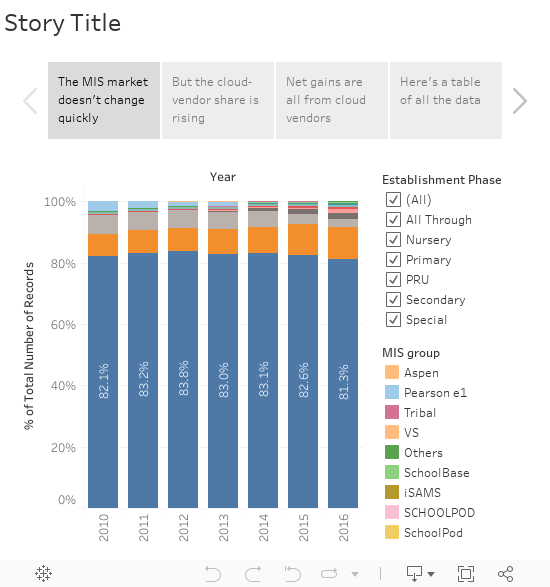
The following Tableau Story takes you through the main headlines in the market. The first visualisation (or "Viz" in Tableau-speak) is the most flexible: you can use the menu options to filter the data by school phase and MIS vendor. Below the Tableau Story, you'll also find my commentary on the state of the market.


So as is seemingly the case every year, the biggest story is... there isn't a big story. (Don't get me wrong, there are medium-sized stories, so please keep reading, Just not a really big one...).  The MIS market moves slooooowly; changes in market share of 0.5% or greater (basically, a move of +-100 schools) are unusual, and therefore can be considered a BIG DEAL.

With that in mind, the big risers are Scholarpack (460 schools up from 305) and Pupil Asset (261, up from 119). It's no coincidence that both are proudly primary focused - it's been apparent for a while that primaries are happy to accept a thinner product than secondaries, providing it is tailored to their needs. They're also apparently quicker to perceive the benefits of the cloud; while RM (by far the largest cloud vendor by market share) serves both primaries and secondaries, its customer base is mostly in the primary sub-sector. Bromcom also deserve an honourable mention for rising from 93 to 155 schools; the biggest increase among MIS suppliers working across all phases.

The biggest drop in terms of absolute number of schools was SIMS (17,888, down from 18,162). However, in terms of market share, the move is hardly spectacular: a drop from 82.6% to 81.3%. Advanced Learning (576, down from 714) also continue to fall, presumably because of customers leaving their legacy "Facility CMIS" product. (The company also provides a newer cloud MIS called Progresso, but the government stats don't separate the two, so it's hard to tell exactly what's going on.)

However, individual vendor data tells only half the story. When you aggregate and compare cloud and non-cloud systems (the second viz on the Tableau story), you see that the market share of cloud vendors continues to rise significantly - up from 11.6% in 2014 to 15.9% in September 2016. In a slow-moving sector, that's a sure sign that something is happening. And actually, these figures understate the rate of change, since I've not been able to count Progresso schools in the "cloud" column, and recent high-profile MAT procurements from Harris (who moved to Bromcom) and AET (who moved to Progresso) are not reflected in the data.

Even more telling is the third viz, which shows how the net gains are all from cloud vendors. There are, in fact, fully nine cloud MIS suppliers with 25 or more state school customers, compared with just two locally hosted systems left in the market (SIMS and CMIS). It's in this context that the recent big announcement from SIMS of a move to the cloud in 2018 should be understood. Of course, many schools still love SIMS just how it is today, but clearly the company's future health is tied to how SIMS measures up to the ever growing crop of cloud contenders.