Pages

Thursday, 12 March 2015

What the sale of Pearson's Powerschool says about the sad state of the global SIS sector

Pearson are looking to sell Powerschool. Here's why, in the words of Pearson CEO John Fallon:
"After careful consideration, we decided that these systems do not align with Pearson’s stated commitment to focus on products and services that shape student outcomes in a way we can directly measure and improve."
That sentence says a lot about the sad state of the global School Information System (SIS) market. The CEO of the company that produces the world's largest SIS (70 countries 13m students; $97m revenues; $20m operating income, according to Edsurge) doesn't see his product as something that can shape student outcomes. Think about that for a second. The SIS is, after all, the home of student data. It's where you store attendance, assessment, exam, behaviour and other contextual data. You know, the things that, umm, shape student outcomes.

I want to stress: I'm not in any way criticising Fallon. His rationale for describing Powerschool as non-core for Pearson does make sense to me. (Mind you, the FT and the Economist are not obviously school improvement products, but that hasn't prompted Pearson to sell their stake in either just yet.) What I'm saying is that his comment points to a terrible truth: the education sector sees the SIS primarily as an administrative tool, rather than as a school improvement system.

It doesn't have to be like this. After all, most school leaders now understand that if you use any half-decent SIS properly, you'll improve outcomes. Strong schools take time to decide what inputs to record. They then use the SIS to store and track those inputs: things like attainment, progress, attendance and behaviour. And most importantly, they analyse the data and take appropriate action based on what it tells them. So the problem is not that the SIS can't improve outcomes; it's that vendors haven't worked out how to give themselves an edge in this area.

Vendors who understand this have an opportunity to disrupt the sector by making it their mission to do exactly what Fallon things is not possible: measure and improve how the SIS can impact student outcomes. Here are some approaches they could consider:
  1. Make it much, much easier to track assessment. Anyone who's set up assessment templates in an SIS will know that it is often a bit of a mission to get a progress tracking system set up in a school. It's harder still if you want to use the same assessment model across multiple schools. There's just way too much manual, non-intuitive work involved. And there's no reason why an SIS couldn't include tools to make data collection and moderation easier, like online tests and past papers. 
  2. Set the data free with open APIs. If you've read my blog before, you'll know that sooner or later I shoehorn in a reference to open APIs. That's partly because I'm by nature a boringly repetitive person. But it's also because I'm right. Indulge me for a second while I rehearse the argument: in any industry, anywhere, ever, innovation in sector-spanning data systems requires agreement on how to share data (think BACS, for example). But way too often, SIS vendors make it hard or expensive to interoperate with other systems. So if you want to build a great testing tool, or parent portal, or analytics system, you have to work really hard to make your system talk to the different SIS out there, let alone integrate with other systems (e.g. HR, finance). That's holding everyone back. So SIS vendors need to start believing in open APIs. Even better, they could converge around common standards and principles. SIF 3.0, anyone? 
  3. Think about how to track the effectiveness and cost of interventions. I've not yet seen any school really nail how they track initiatives (new curricula; one-to-one interventions; pupil premium spend) in a way that properly interrogates their value for money and impact on progress. That's in no small part because I'm not aware of any software that really makes this easy to do. SIS vendors might want to get on that.
  4. Be more global. Powerschool is a rarity, in that it is a global SIS. Most vendors make a system for their home market, and in doing so, they keep their horizons - and development budgets - small.
  5. Integrate the SIS more tightly with the learning platform. To move this along, one of the big platform vendors, like Blackboard, could buy one of the big SIS, like Powerschool. Oh, hang on...
A huge amount of money is flowing into edtech, but school information is not getting its fair share of investment. And yet, when used in the right way, the SIS really can be a school improvement goldmine. It's time for investors and innovators to open their eyes to its potential.

Monday, 9 February 2015

MIS Market Moves: SIMS stride on; the Cloud gathers momentum; innovation will come from smarter procurement

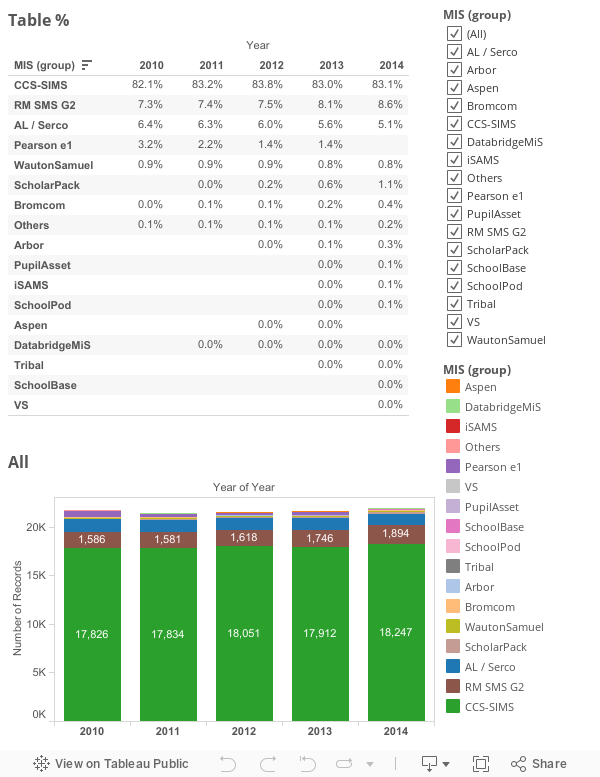
If you're interested enough in school Management Information Systems (MIS) to to read this blog, chances are you already know that Capita's SIMS dominates the English market. What may surprise you - particularly if you went to BETT this year and saw the many shiny stands promoting rival vendors - is just how hard others are finding it to establish themselves. Over the past five years, SIMS has actually managed to grow its footprint slightly, rising from an 82.1% market share in 2010 to 83.1% in 2014. Pity the poor blogger who attempts to spot exciting trends behind that headline story.

And yet. Thanks to the discovery powers of Tableau, and the granularity of data on school MIS choice that we now have at our disposal*, there are actually all kinds of fascinating things we can deduce from looking more closely at what's going on. But before I get to my conclusions, have a look for yourself. Here's a Tableau dashboard showing MIS data over five years. You can use the check boxes in the top right corner of the dashboard to include or exclude data from specific supplier. (E.G. if you uncheck "CCS-SIMS" you'll see the five year trend excluding SIMS.)


So, after wading through the numbers, here are my main insights.
    1. RM is now the nation's clear second-favourite MIS. Since 2010, RM has increased its market share from 7.3% to 8.6%. That's almost 2,000 schools using their system. And, significantly, the third and fourth favourite suppliers from 2010 (Advanced Learning and Pearson respectively) have dropped away since then. AL has declined from 6.4% to 5.1%, and Pearson have exited the market entirely. Scholarpack has finally broken the 1% market share barrier, but in the big picture, everyone else is still a rounding error.
    2. Cloud suppliers are steadily gaining market share. It's hardly a revolution, but those suppliers who ARE gaining share are doing it from the cloud. RM (1,586 schools in 2010; 1,894 in 2014), Scholarparck (0; 244), Bromcom (5; 85) and Arbor (0; 66) now have a 10.4% share between them. 
    3. If you want to succeed, find yourself a niche. SIMS has actually lost primary market share in each of the past three years. That makes sense, because it's also the area where they're experiencing the most competition. Scholarpack, for example, is an apologetically primary-focused solution: they don't have an exams module, so if you have a GCSE cohort, they wouldn't be able to handle your requirements even if you wanted them to. And RM's growth seems to be tied to an increasing primary focus: in the secondary market they're actually declining quite rapidly (they had 60 secondaries in 2010 but that had dwindled to just 27 by 2014). SchoolPod are also interesting - in 2013 they had three schools (a big academy, a studio school and a special school) but since then their growth to 20 schools has come about exclusively from special schools and PRUs. All this points to the fact that it's complex and costly to make a MIS that suits all schools, so it's understandable that some suppliers aren't even trying.
    4. The market may be tough to break in to, but that won't stop 'em from trying. A cautious tech entrepreneur might look at teh numbers and conclude that the English schools MIS market is more hassle than it's worth. But clearly caution is not in abundance in such circles, because since 2010, no fewer than TEN suppliers have decided to have a crack. In order of popularity, they are: Scholarpack, Bromcom, Arbor, Pupil Asset, iSAMS, SchoolPod, Aspen (deceased), Databridge, Tribal, Schoolbase and VS. Between them they can boast almost 500 schools. Welcome, folks.
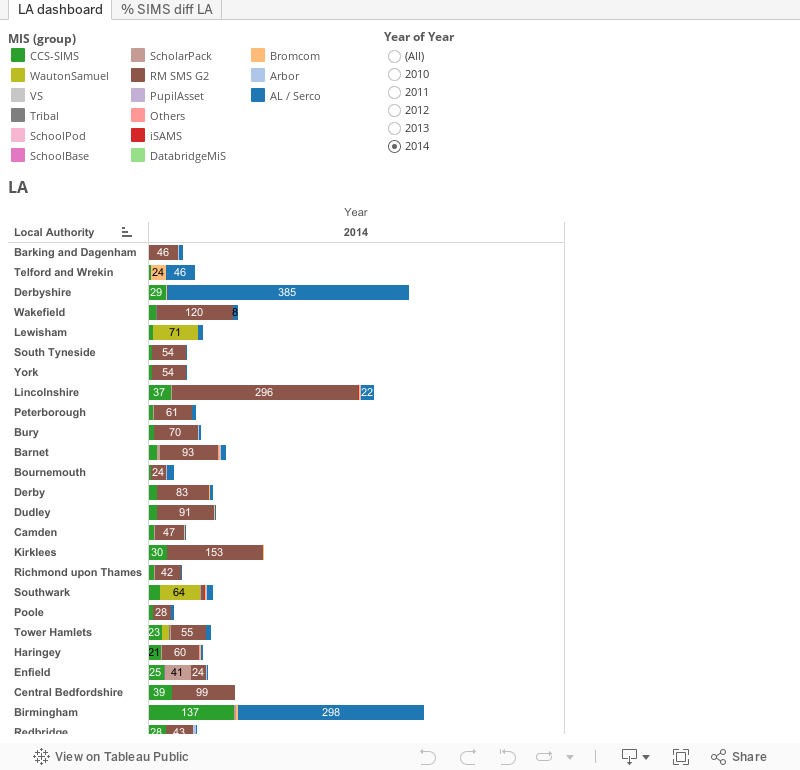
So that's the national market. But it gets even more interesting when you look at the data broken down by local authority. Here's an interesting question, which you can use the following Tableau visualization to answer: over the past five years, how many LAs have undertaken procurement exercises that have had the effect of reducing the SIMS market share in the borough by more than 15%? Look at the "% SIMS diff LA" tab and you'll see the answer is.... 


...Two. Yep, only Oxford (53% decline) and Cumbria (35% decline) have seen a significant change in SIMS market share in the past 5 years. Props to Scholarpack, RM and Bromcom, who have all won over schools in these LAs. And, to be fair, props to SIMS for maintaining such a strong position. But let's be clear: the story behind these data is not that LAs keep running big, open tendering exercises and SIMS keeps winning. I'm told that only two procuring bodies have actually used the government's IMLS procurement framework in the past three years. Of course, there are other procurement routes, but I don't think it's controversial to deduce from this that large-scale, open procurement processes are a rare beast in the English MIS market. Until this changes, the market will stay stifled.

This brings me back to the conclusion from my last post on the subject: those of us who want to see more innovation in the MIS market have a responsibility to procure in a way that gives everyone a fighting chance of winning business. Personally, I'm an increasing fan of localised frameworks that give a subset of schools (one or more LAs or Academy Federations) the ability to purchase from a shortlist of approved suppliers. To their credit, Telford & Wrekin and Middlesbrough have both taken an approach along these lines, though Middlesbrough have also been open about the complexity of running such a process. But all challenges are surmountable - and LAs who share their experiences do the rest of us a commendable service, since we can all learn from how they've handled things. So whether you're a standalone school, an Academy Federation or a Local Authority, please think about the bigger picture when you choose your MIS.

* The data used to prepare this blog came from FOI requests over the past five years, and most recently from the irrepressible Graham Reed. As well as helping to get hold of the data, Graham also kindly makes the raw data available to interested onlookers in a historized form. Graham works for Groupcall and also runs the Eduware Network. His Twitter handle is @grazreed. He is well worth a follow.

Sunday, 2 November 2014

MIS MARKET MOVES 2014: SIMS still dominate; Scholarpack and RM are up; Advanced Learning are down

Good news for School Information System obsessives like myself - I've got hold of some newish data on English market moves from the past year. There's lots to report.

But first, a quick word on the data source. It turns out that the DfE have now agreed to circulate raw data on MIS market share to vendors, and one of them has been kind enough to share the 2014 files with me. In preparing this analysis I've therefore combined these new datasets with the 2012 and 2013 autumn census information I used in my previous blog on the same subject.

So, as last time, here's the data in Tableau for you to play with, followed by my take on the main headlines.


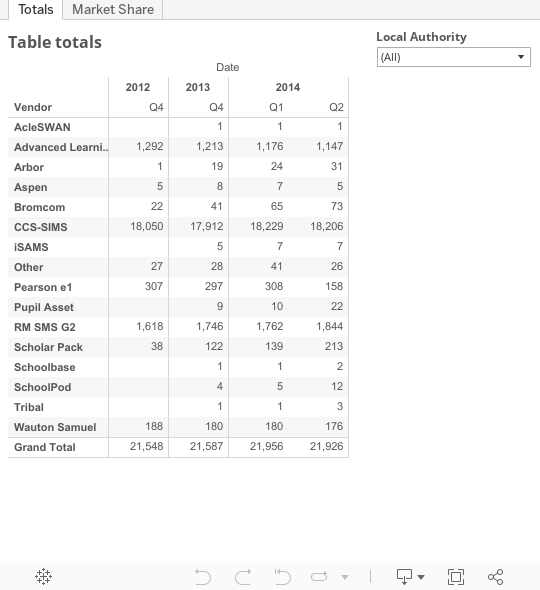
What jumps out immediately is that Capita's SIMS clearly know how to hold on to an 83% market share. In my last article I pointed out that SIMS had seen a significant reduction in schools using the system between 2012 and 2013. Well, the new data show that they reversed those losses (and then some) by Spring 2014. At the last count they were serving 18,206 schools. (Incidentally I recently discovered that SIMS really don't like selling licenses that start on any day other than April 1st, so I guess it follows that Spring is when all their annual gains show up.)

Looking beyond SIMS, there are two obvious winners and one big loser.

RM (1,844 schooks; 8.4% market share) and Scholarpack (212; 1%) will be the ones celebrating - they've each added close to 100 schools over just two terms. In the case of Scholarpack, one reason for the rapid growth is that they seem to have worked out how to win a big local authority contract. You can see this from the above tables: go to the "totals" tab and filter for Cumbria LA. You'll see Scholarpack now have 106 schools in the region. Most of those schools switched away from SIMS. So while SIMS look secure for now, that could change rapidly if more LAs start to see insurgents like Scholarpack as a viable alternative.

Advanced Learning (1,147; 5.2%) are once again the big loser. They've shed another 66 schools over the past two terms. And don't forget these figures represent combined sales from their legacy product (Facility CMIS) and their new cloud offering (Progresso). 139 schools also moved away from Pearson (158; 0.7%), but seeing as they're no longer even supporting their product, if anything the surprise is that 158 schools are still persisting with the software!

What of the smaller pretenders? Well, it's mildly surprising that Arbor (31; 0.1%) aren't gaining market share faster - it feels like a lot of people are talking about them, but this this isn't yet flowing through into significant sales. Bromcom (73; 0.3%) picked up a creditable 32 schools over the two terms of new data, but like Arbor, they haven't yet managed to break into three figures. Pupil Asset (22; 0.1%) are emerging as one to watch - they are selling a MIS off the back of their primary assessment tracking software, and this "upsell" strategy seems to be bearing fruit. iSAMS and Schoolbase are both strong in the independent sector, but they're not really getting any traction in the state sector yet. And spare a thought for Tribal (3; 0.0%) - they're big in university MIS, but after two years of plugging away their school system (Synergy in Schools) is struggling to sell to anyone.

What will it take to bring about really significant change in the market? Well, the smaller vendors could make a bigger deal about how they can remove the barriers and costs of switching. They could also be clearer about which segments they are targeting with their functionality (Primaries? Academy Trusts? Local Authorities? Schools with a strong analytics focus?)

A final thought: I do think that commissioners (like academy trusts and local authorities) can play an important role in increasing competition in the marketplace. For example, they could structure procurements in a way that creates room for more than one vendor to share the business. After all, there are more and more ways for commissioning groups to aggregate data from multiple schools without them all being on the same system (e.g. by using products like Groupcall Xporter and Zinet Connect). Ultimately, if purchasers want to see more innovation, they have to create a procurement environment that allows smaller vendors a fighting chance.

Tuesday, 2 September 2014

Dear graduates, school data management is the best career you've never heard of.

Everyone has been taught, so everyone knows that teaching is a viable career choice. Schemes like Teach First and school-led initial teacher training programmes mean that there are more ways than ever to train. So if you want to be a teacher, and you are capable, there's a good chance you'll get to be one.

However, speak to any head and they'll tell you that they need more than great teachers. All kinds of non-teaching roles also contribute to a school's success. And in the world that I work in, the key person is the data manager. It's a sometimes unheralded, but always pivotal, position.

You can't be an outstanding school without being on top of your data. But where do you go to find a great data manager? It's a question that's regularly asked in the country's secondary schools, since nearly all of them employ at least one data person. And the reason they need to ask it is because it's devilishly hard to find them.

There are lots of reasons for this supply/demand imbalance:
  1. Graduates don't know the job exists. You won't find any evidence of the role at careers fairs. So graduates don't consider it as a viable pathway. Most people fall into it by accident - they stumble across an ad, or they hear about the role from a savvy school-based acquaintance who spots their relevant skills (numeracy, IT, spreadsheet wizardry etc) and converts them to the cause.
  2. Schools are not always well placed to train data managers. Most schools only have one data manager, so there's rarely a more experienced colleague around to pass on their accumulated wisdom. Data managers may be line managed by either a school senior leader (the assessment co-ordinator, for example), the Head, the Finance & Resources Director or the IT manager. This means that there's a high chance that their boss doesn't know how to do the job in detail. That's entirely understandable given the other things these people do - but it does make training tricky.
  3. There is no relevant accreditation or induction of any sort. I am not aware of any formal data manager qualification. That's a problem that you don't find in other professions where practitioners may have a unique skillset within their organisation. For example, before they go "in-house", lawyers and accountants go through a slick training process via a large employer or a university to turn their raw talent into proper expertise.
  4. Prospective data managers can be put off by the misguided perception that there is a lack of career progression. Many data managers I've met have expressed a concern about how to move onwards and upwards in the data manager world. After all, if you're the only person with your skillset in the school, you can't really aspire to a more senior position within that school. But I think there are loads of great things that data management can lead to... and so below I'll give some options.
Points 1-3 are structural problems with education that I've discussed before, and my team spends quite a bit of time thinking about how ARK can help to solve them. For example, we're building a team of great central data people who support our schools, and in some cases actually do the job of a data manager on behalf of our schools. In the latter case, the school buys into a service from our skilled team, rather than relying on a single individual based at the school to do the job. Our hypothesis is that this is cheaper (because the school only pays for the number of days they need) and better (because the service is provided by a well-trained team with a range of specialisms). But it's early days, and there's loads we need to do to improve things further.

Point 4 stems from a lack of understanding of the richness of the broader education data sector, and also of the transferability of the underlying skills. Here are just some of the things you could do with a data management background:
    • Move to a different education data role. There are way more relevant roles than you might imagine. This very useful blog lists 14 UK SIS providers - and they all need school data skills. Most local authorities have data teams, usually containing people with a school data manager background. Data is huge in higher ed. Edtech more generally values people who understand school data. You could create your own edtech startup. I have a pretty cool job - and I'd probably be better at it if I'd been a data manager at one point. I could go on.
    • Move to a different data / analytics role in a different sector. Data is a huge growth area. There aren't enough people with good data skills. So if you want to move to another sector, with a bit of CV finessing you'll be very well placed. For example, our data people are starting to use Tableau - an awesome data visualisation tool. Try googling jobs for people with experience of working with Tableau. There are more and more of them every week, and they pay well. So school data is a great entry-level route into data more generally.
    • Move to a different school. Increasingly, you can progress just by moving to a different school or academy group. I've met data managers who cover two or more schools within a Multi Academy Trust. Academy groups also now have people covering lots of schools called things like "Director of Data". Bigger schools can have 2+ data people. And you could use the skills anywhere in the country. Career progression doesn't have to mean more money - it could involve the opportunity to use your skills in a different part of the country where you'd be happier.
So if you're smart, and struggling to find your calling, and you like numbers / spreadsheets / databases / technology, you should look seriously at a career as a data manager. And if this tempts you as a career option, but you're not sure what to do next, do get in touch for a chat (twitter is a good way of contacting me). One of our team would be glad to meet up with you to discuss the sector in more detail...

Tuesday, 1 July 2014

You want a free School Information System? Try SchoolTool.


A group of us at ARK (@ARKcharity) and PEAS (@PEASchools) are collaborating to work out how to approach the School Information System (SIS) in developing countries. The first task is to get something working for the PEAS network of 24 secondary schools in Uganda. But we’d also like our solution to be viable for publicly funded schools in any developing country.

To have a sense of the size of that challenge, you need first to understand the funding disparity between schools in the developed and developing world. Let’s take rich countries first. The latest data show that OECD countries annually spend $7,637 from primary through tertiary education, on average. The cost of the SIS in England currently hovers around the £10 ($16) per pupil per annum (pppa) mark, or around 0.02% of total funding. So basically, if you are a school in a developed country, you can afford an SIS.

However, for schools in developing countries, it’s an entirely different story. It's harder to find up-to-date data from the developing world, but research from our international team shows that per-pupil expenditure is generally between $40 and $150 in Sub Saharan Africa (South Africa is the exception, at over $1,000 per pupil per annum). In India it is not a great deal higher - the primary average is a little over $200. So a School Information System at UK prices would effectively swallow up to a third of a Sub Saharan African school’s budget. Given that schools need things like teachers, buildings and books, that's clearly a non-starter.

With that in mind, the PEAS / ARK hypothesis has been that the developing world needs a free, open-source system with minimal support requirements. (Remember, it needs to be affordable even at per pupil funding of $40 pppa!) It would also have to have decent functionality, covering all the key areas such as attendance, assessment, behaviour, fees, timetable and reporting. And it would need to handle both network and individual school reporting needs. That’s quite a big ask.

At first we thought we’d have to build something from scratch. But then we researched the market, and we found that quite a few projects with similar aims were out there already. The following seven were all promising:


Of these, the ones in bold (with links) were the most interesting, so we looked into them in a bit more detail. And, in our opinion, SchoolTool was the best. It is still being actively developed, it has solid technical underpinnings, and an impressive array of functionality. We also liked the fact that it had the backing of the Shuttleworth Foundation, the charitable vehicle of Mark Shuttleworth, the founder of Ubuntu. Some of the systems we looked at took a "freemium" approach, where the entry-level free version can be upgraded to a premium, paid-for option. We like that business model in principle, but we needed more functionality in the "free" version than was available in those we studied. SchoolTool, on the other hand, wants to be free: it is open-source in the philosophical, as well as literal, sense.

SchoolTool has some technical quirks – it only runs on the Ubuntu operating system, for example, and it’s been developed using the increasingly archaic Zope Python framework. But these are fairly small quibbles and by no means deal-breakers; the more important thing is that it’s free, and it works.

Our requirements went beyond SchoolTool’s current specification, so we paid for some further development to increase functionality and make it work for a network (as opposed to a standalone school). Then in mid-June Sunesh (one of ARK’s SIS systems gurus) went out to Uganda with Sabina from the international team to get it set up in two pilot schools. (Sabina’s Twitter feed has several photos fromt the week, including this one of a training session in mid-flow.)

The initial feedback from PEAS is really encouraging. We’re told the schools are finding it valuable and easy to use. It also runs on cheap hardware, so the support requirements should be minimal.

There are one or two technical teething problems (for example, it turns out that Ugandan mobile Internet Service Providers don’t like it when you try to push scheduled data packages over their network. Who knew?) But they all seem surmountable, and anyway, that’s why you have pilots, right?

Long-term, I wonder whether anyone will ever work out how to make a School Information System that looks like a platform and which solves developed AND developing world problems. It doesn’t seem too far-fetched to me to imagine an SIS that combinesMoodle’s open-source approach and depth of functionality with Salesforce’s usability and appExchange. But until that exists, we reckon SchoolTool is a great way of getting your developing world school (or network of schools) online. And crucially, it’s free, which is my favourite price.

Saturday, 10 May 2014

Denmark and Netherlands: 2014 Eurovision dark horses

I'm attempting to predict the Eurovision winner. It's 10.42pm and they're about to vote, so this could become an embarrassingly inaccurate post in under an hour... But nonetheless, let's give it a go.

Looking at historical results, the thing that really stands out to me is that in the past nine years, nobody has won Eurovision from earlier than 17th on the running order. (There have been between 24 and 26 entries each year.)

This Tableau visualisation shows the average points for each position in the running order using data from the past five years. It's pretty clear that performing between 17th and 24th is a good thing.


Right now the very strong joint favourites are Austria and Sweden. They performed 11th and 13th respectively. Hmm.

The most favoured countries performing between 17th and 24th are Denmark, Spain and the Netherlands. Of those, Denmark has the strongest record over the past 5 years. Nobody hates the Danes, so they don't suffer from any boycotts when the voting comes around. And Sweden, Norway and Iceland usually come through with a helpful high score for them. None of that means they'll win necessarily. But I reckon they're a decent dark horse. I also wouldn't rule out the Netherlands - they were solid last year and also benefit from being seen fairly universally as a country of Good Folk.

Of course, Austria and Sweden may have the better songs... but nobody really thinks it's a song contest... right?

Update 11th May, 9am
So I didn't pick the winner. Austria took the prize from 11th in the running order. I guess their act was memorable (an endearing, bearded drag act called Conchita Wurst), which may have helped to counteract the less favourable place in the running order.

However, one of my two picks, the Netherlands, did come a close second. That's encouraging. It remains pretty obvious that countries placed 17th - 24th get a big points boost.

Monday, 21 April 2014

How the DfE could turbocharge innovation in edtech

I was at the hugely inspiring Emerge Education event last Thursday night. A big theme of the night was how to remove the barriers to innovation in UK edtech. Listening to the diverse pitches, it struck me that most of the products in the first Emerge cohort need some form of data interoperability to make them work. That’s not easy in the UK right now.
Here’s the problem. If you dream up a great edtech idea with the goal of improving student outcomes (like the promising, Emerge-backed Reward System, for example) the chances are you want your product to interact with pupil information. That data is stored in the School Information System (SIS) - eg SIMS, CMIS etc. Right now it is hard to get to that data, for the following reasons:
  1. It's complex and costly to connect to all vendors. If you want to sell to all schools in England, you need to interact with quite a few school information systems. SIMS may have 83% of the market but RM and Advanced Learning also have over 1,000 schools each, and increasingly, recent entrants like Arbor and ScholarPack are gaining ground (my previous blog post covers the market in more detail). So if you want to interact with all of them, you need a way of maintaining multiple interfaces.
  2. It’s complex and costly just to connect to SIMS. OK, you might say, so I’ll just sort out an interface with SIMS, since that covers the majority of schools. Well, Capita will let you do this, but they'll charge you to be a partner. Their APIs also don’t give you access to all data in all ways, and you need Visual C skills to use them.
  3. Vendors have different data models. In an ideal world, all vendors would coalesce around a common data interoperability standard to make it easier for people to interact with different SIS. Something like SIF, for example. The problem is, in the UK we’re a long way away from an ideal world. Opinion is divided on whether the SIF specification adequately covers everyone’s needs, and anyway, adoption is patchy. In the US, initiatives like Ed-Fi offer an open-source data model (a bit like SIF) which states and districts are adopting. That leads vendors to standardise their data models around that framework. However, one of the reasons this approach is gaining traction there is that the American SIS market is much more fractured. In a fractured market, adoption of a common standard benefits everyone. That is not the case when there’s a dominant player, since there’s no incentive for the market leader to accept the trade-offs that come with standardisation. In fact, there's a powerful disincentive, since openness encourages greater competition.
  4. The UK doesn’t yet have its own “Clever”. Looking to the US once more, Clever is solving the problem laid out in point 3 above by offering an easy-to-access, best practice (“REST”) API layer with start-up friendly business models. The closest thing to that in the UK is Groupcall Xporter, which lets you access data from multiple MIS. It’s helpful, but my understanding is that it is a scheduled extraction tool, rather than a REST API, which would offer full read/write access to an application. Groupcall also comes at a cost which may prove be prohibitive for startups.
So how do we solve the problem of data interoperability in the UK? Well, one great place to start would be for the government to make data interoperability an eligibility criteria for the next IMLS framework. This framework is the main procurement route by which schools, LAs and academy groups choose their SIS. In other words, it's important, and software vendors care about being on it.

Specifically, the DfE could specify that products need to have free, open source, fully documented,RESTful APIs to be IMLS-compliant. That would make it much easier and cheaper for edtech companies to interact with the SIS, and it would also lead to the rapid emergence of cost-effective, Clever-style products. It would also nudge vendors from a closed-product mentality towards a platform mindset, where others are encouraged to interact with or build on top of the system. (As I’ve said before, I like platforms.)
This may all sound rather niche, but the more I look at the area, the more I think that the DfE should take a stand on data interoperability. It could be the small step that leads to big innovation in edtech.