Pages

Tuesday, 1 August 2023

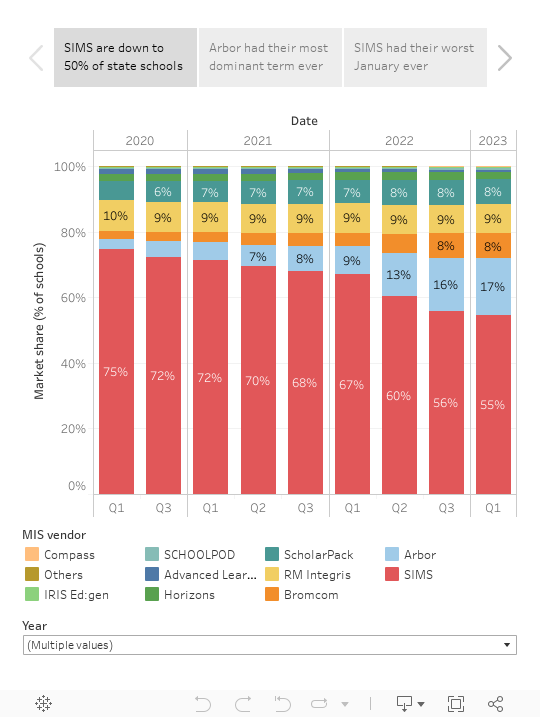
MIS MARKET MOVES SUMMER 2023: fewer than half of primaries are now using SIMS

UPDATED DISCLAIMER: I have past commercial relationships with a number of MIS vendors. I'm also a co-founder of two assessment ventures - Smartgrade and Carousel - that exist in markets adjacent to the MIS. Nonetheless I aim to write this blog impartially, from the perspective of a neutral observer. This matters to me - it's basically the blog I wish had existed back when I was a MAT senior leader trying to get a handle on MIS and edtech. I also now provide MIS market datasets as a service and offer free, informal consultations on MIS procurement to schools and MATs. If you would like to discuss any of this, contact me on Twitter or LinkedIn.

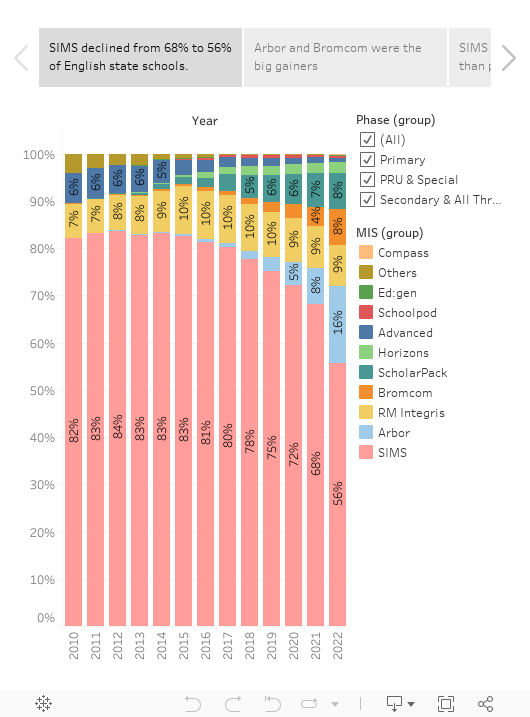
In autumn 2018, SIMS was the chosen school Management Information System (MIS) for 76% of England's state primaries. At that time, Bromcom and Arbor's combined market share was 2%. In the five years since then, we've witnessed the kind of shift that happens rarely in the often slow-moving world of edtech. The summer 2023 data, which I just got my hands on this week, shows that SIMS's market share is now below 50% of primaries for the first time since I've been tracking the market. What's more, The Key (who now own Arbor, ScholarPack and RM Integris) are up to 40% between those three brands. So it's not even really accurate anymore to describe The Key as a challenger: on current trends, The Key will be the largest supplier of MIS to the primary sector within a year.

As always, here are some pretty charts summarising the latest data, followed by a few more observations:
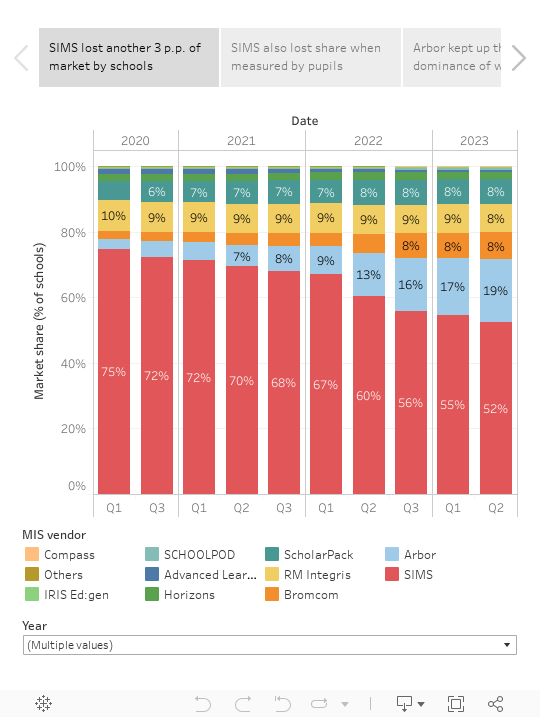

  1. Arbor is steadily catching up with SIMS. Arbor is up to 4,240 schools overall, compared to 11,545 for SIMS. Nobody else breaks 2,000. They've now been the fastest grower for at least ten terms in a row.
  2. Bromcom keeps growing too, with 1,851 schools and 11% of the market in the latest data when measured by pupil numbers. They've captured 14% of academies, and they're now up to 4% of LA schools following some notable procurement successes. Arbor remains the faster grower, with over twice the number of schools on its books, but Bromcom is doing a good job of maintaining a growth trajectory, and stands out as the clear third place vendor. 
  3. It was a poor term for the other challengers. I was pleasantly surprised to see IRIS Ed:gen rise from 18 schools to 86 schools during 2022 (incorporating schools still on iSAMS). While they were no doubt helped by SIMS's bummer of a year, that's impressive growth by any standards, and marked them out as a potential breakout candidate in 2023. Well, that hasn't happened yet. In the past two terms, they've added just 4 schools net to be serving 90 schools in total. And things have been even worse for Juniper Horizons, which has 487 school customers (including those still on Pupil Asset), down from 510 at the same time last year. Three terms without growth might be considered something of a warning sign, and I wouldn't be surprised if other MIS are starting to eye up their customer base. In Norfolk, for example, where Juniper have over half of their schools, Horizons/Pupil Asset lost 10 schools in the last year. I'll keep an eye on market share in this LA as it seems like a bellwether for the broader performance of the MIS.
  4. Compass came from Ireland, and now they're doublin'. As I've mentioned in previous posts, until recently I was an advisor to Compass, the Australia HQ-ed MIS who established a strong presence in Ireland in recent years before winning their first English school in late 2022. In the January 2023 dataset they were up to 4 schools (from 1 the previous term), and that number has now doubled to 8. Compass are the first truly new entrant to the market since Pupil Asset, SchoolPod and iSAMS a decade ago, so they're offering us a fascinating real-time case study in whether it's possible for outside players to break through in England. For a first year in a very competitive market, this is a solid start.
  5. Plenty of schools are still switching. When SIMS moved to a "3 year lock-in" strategy in late 2021, their hope will presumably have been that after a brief flurry of switching, schools would stick with them on longer contracts while they got a cloud alternative to their core locally-hosted product to market. Yeah, that's not happened, though. Progress is being made with SIMS Next Gen - some primary assessment features were recently announced, for example, but it's some way away from being a finished all-phase product. In the meantime, 601 schools switched MIS between the Spring and Summer 2023 terms, and fully 474 of those were moving away from SIMS. Or to put it another way, more schools left SIMS last term than switched from any system in any full year between 2010 and 2013. I'd say we're on track for 1,300 to 1,600 switchers during the academic year, the majority of which are leaving SIMS.
  6. Advanced still have 149 schools on their books. Earlier this year Advanced announced that their MIS products were going end of life. So far, only 9 schools have left them this year, meaning that 149 need to find a new MIS home by September 1st. So alongside SIMS leakage, this is another factor keeping the switching market buoyant in 2023.
  7. Finance is now firmly part of the MIS equation. LAs are increasingly procuring a new finance system at the same time as a MIS. Bromcom have been proudly announcing big LA finance wins. The Key have rebranded RM Finance as Arbor Finance. IRIS is growing a state school MIS business off the back of its popular MAT finance system. So while you clearly can sell a MIS without a finance system, you'll increasingly find yourself in the minority if that's what you're doing.
One final thought on what it might take for a newer challenger to break through. I don't think it's enough to be "another solid cloud option" anymore - Bromcom and Arbor are too-well established and will be perceived by many as a safer option if there's no clear and compelling differentation. So instead I think you need to focus on breakthrough features to stand out from the crowd. That's hard in MIS world, when you may feel a pressure to have an extensive list of modules just to participate in the market (and that number seems to go up all the time). But I can't see a tonne of other ways to get heard in such a competitive market.

Sunday, 7 May 2023

MIS MARKET MOVES SPRING 2023: The Key are now in a third of English state schools

Disclaimer: I have past and present commercial relationships with many MIS vendors, including an ongoing role as an advisor for Compass. I'm also a co-founder of two assessment startups - Smartgrade and Carousel - that exist in markets adjacent to the MIS. Nonetheless I aim to write this blog impartially, from the perspective of a neutral observer. This matters to me - it's basically the blog I wish had existed back when I was a MAT senior leader trying to get a handle on MIS and edtech. I also now provide MIS market datasets and reports as a service and offer free, informal consultations on MIS procurement to schools and MATs. If you would like to discuss any of this, contact me on Twitter or LinkedIn.

I recently got hold of the January 2023 census data. Truthfully, the release at this time of year is never earth-shattering - it tracks schools who move MIS between October and January, and that's just not a super-popular time to switch school systems.

But there were a few things of interest in the numbers, so I'm cranking out a blogpost regardless. As usual, here are the charts, with my analysis below.


  1. SIMS had their worst winter since (my) records began. SIMS lost 242 schools over the period. That may not sound like much, given they lost over a thousand in each of the preceding two terms, but it's more than they've ever lost over that part of the year since I started tracking things over a decade ago (the next highest was last year, when they lost 228 schools). That's significant, in that it indicates that SIMS's move to 3 year contracts (and associated break clause controversy) hasn't stemmed the tide yet.
  2. Arbor had their most dominant term ever. 301 schools switched MIS over the period. 236 of those (76%) moved to Arbor. This may in part be because other vendors don't encourage schools to switch over the Christmas period; but still, it's clear that Arbor remain the leading challenger.
  3. Once the RM Integris acquisition is finalised, The Key will be serving over a third of English state schools. The Key are buying RM Integris, and providing that sale completes following the current CMA investigation then the group will be providing MIS to 34% of the country's state schools. SIMS are at 55%. So I think we can all officially stop referring to SIMS as the dominant market player - there are now two big fish, and only one of them is growing. To misquote the Urban Cookie Collective, they are The Key and they've got the secret.
  4. Compass grew by 300%. In the autumn census Compass had their first school show up. Well, now they're up to 4, giving them a 300% term-on-term growth rate. If they can keep this kind of growth rate up for the next five years then it is a statistical fact that in 2028 they will be working with over a billion schools. (This is the kind of quality analysis I provide to companies who come to me for advisory services.)
  5. Spare a thought for Rufford Primary School, the most recent Advanced adopter. Since this data was captured, Advanced have announced that they're shuttering Cloud School this summer. That leaves their 158 schools just two terms to find another home. The news isn't in itself that surprising - the writing was on the wall once their largest customer Academies Enterprise Trust switched to Arbor a year or two ago - but the short timeframes for customers to find a new home is somewhat eyebrow-raising. Which brings me to this blog's "Gah That Sucks" award winners of 2023: Rufford Primary School! Rufford joined Invictus Learning Trust - a MAT-wide Advanced customer - in September 2021, and switched to Advanced last autumn, presumably so that the Trust could have all schools on the same system. So do spare a thought for the poor folks in that school office who trained up on a new system, only to find that they'll have to move to their third MIS in the space of a year by the summer. Ouch.
To conclude, I'd just say that the next set of data (based on the May 23 school census, which I usually get hold of around August time) will be a biggie. It's traditionally been the period when you see the most SIMS switches in a year, because SIMS contracts used to run until 31st March. So if the move to 3 year contracts is going to help them, we should see that reflected in the May data. In 2021 (before the three year contract drama kicked off), 456 schools left SIMS, so if they can keep their losses below that threshold then I guess that's a win for them? But if they lose say 500+ then it'll be hard to see how all the suboptimal publicity has been worth it.

POSTSCRIPT: I'm hiring for a customer support associate at the moment to work with me at Smartgrade / Carousel. Edtech / customer service experience would be great, though it is not essential - the ideal candidate will be smart and quick to learn and as geekily excited as I am to work in the world of school assessment. Pay is £22-30k. If you think that might be you, or you know someone who could be interested, then apply here.

Thursday, 23 March 2023

Compass: a new direction for UK MIS?

I’ve been involved in MIS in one way or another since 2012. Candidly, I’ve spent quite a bit of that time frustrated about the state of the market. In 2014 I wrote a blog entitled The structure of the education sector makes data innovation really hard, which contained this observation:

The "MIS" market is not structured to foster innovation. 83% of schools in England use Capita's desktop-based SIMS product (this helpful Edugeek post has the full breakdown). Cloud-based systems such as the promising, primary-focused Scholarpack are barely 1% of the market. Capita are not exactly hurrying towards the cloud. Maybe this is because they are happy with the way the market is working for them. Maybe I'd feel the same if 17,912 schools were paying me to sell them a legacy product.

Well, SIMS have lost over 30% of their schools since then, and yet they still don’t seem exactly to be rushing to leave those locally hosted roots behind. Their cloud product, SIMS Next Gen, was launched in Autumn 2021 and yet the Next Gen marketing site still focuses mostly on “the first slice 'Take Register'”. 


So if innovation is not exactly gushing forth from SIMS, where do we look for it? Well, I took on an advisory role at Compass, the Australian HQ-ed MIS, two years ago precisely because I was keen to see more new thinking in this space. And now that their first English schools have gone live it seems like a great time to catch up with UK General Manager Pete Collison to find out more about the identity they’re carving out for themselves. Here’s a rundown of our conversation.


[Josh] Hi Pete. How did you get into the wonderful world of MIS?

[Pete] I’ve spent 20 years in edtech, mostly with RM and all in school-facing roles. In the past 5 or 6 years I’ve specialised in assessment, and that gave me exposure to RM Integris, the company’s MIS. What really struck me was how big the MIS ecosystem is and how many elements of the school day it touches. Conceptually a MIS covers everything from signing in to school in the morning through to taking registers throughout the day, managing lunch and handling clubs/trips and assessment. That’s a lot, right?


So when the opportunity came to move to Compass - I was excited to get stuck into the sector, and particularly to work with an established vendor that’s new in the UK. It felt like the perfect mix of a startup’s agility but with an established company behind it.


OK, so tell me about that ‘established company’. What’s the Compass story?

Well it’s a bit of a Silicon Valley-style story. The company is still run by the founders, John and Lucas, who met over lunch whilst working for AXA Australia, and bonded over their shared passion for Edtech. Compass 0.1 was essentially borne out of them looking to automate some of the more simplistic processes of schools. The first few months of Compass’s life was spent in Lucas’s parents’ garage, whiteboarding the school processes they wanted to automate! We’ve grown rapidly to serve over 2,000 schools in Australia and Ireland since then, but the company still feels quite startuppy in its culture. It’s founder-run, purpose driven, and fast-moving. And we are proud that Compass school number 1, Balwyn High School in Melbourne, is still a key customer to this very day!


The nice thing about how we’re approaching the UK is that while we benefit from Compass’s global credibility and broad range of pre-existing features, we also have a very substantial team here with its own identity, so all school interactions are handled from the UK. We’re very hands-on - we collaborate closely with schools and make frequent onsite visits to ensure that we understand their needs. We’re always on site when schools go live, so it’s a high touch and human service. I think this is one thing that really sets us apart: we make time for every school and they get a lot of time from us before, during and after migration to make sure it goes as smoothly as possible.


Right, so tell me more about the Compass strategy in the UK


The great thing about Compass is that we’re a fully-featured MIS, with a really broad range of modules, so we can be a one stop shop if schools want; but equally we integrate with other systems and we’re very happy to give schools complete flexibility to use other software alongside us if they so wish. In other words, we are very mindful that Compass is part of a school ecosystem, and we know that it’s for a school to decide how we fit into that.


I believe choice is good. It improves innovation and ultimately that leads to better outcomes. I’d love schools to choose Compass, but regardless, by increasing choice we know we’re doing a good thing.


Importantly, we also feel there’s a space for a vendor who is genuinely purpose-led. Compass is a for-purpose company, not a for-profit company. That dictates our behaviour and how we support our customers.


You mentioned there that you’re fully featured - tell me a couple of areas where you really stand out from the competition.


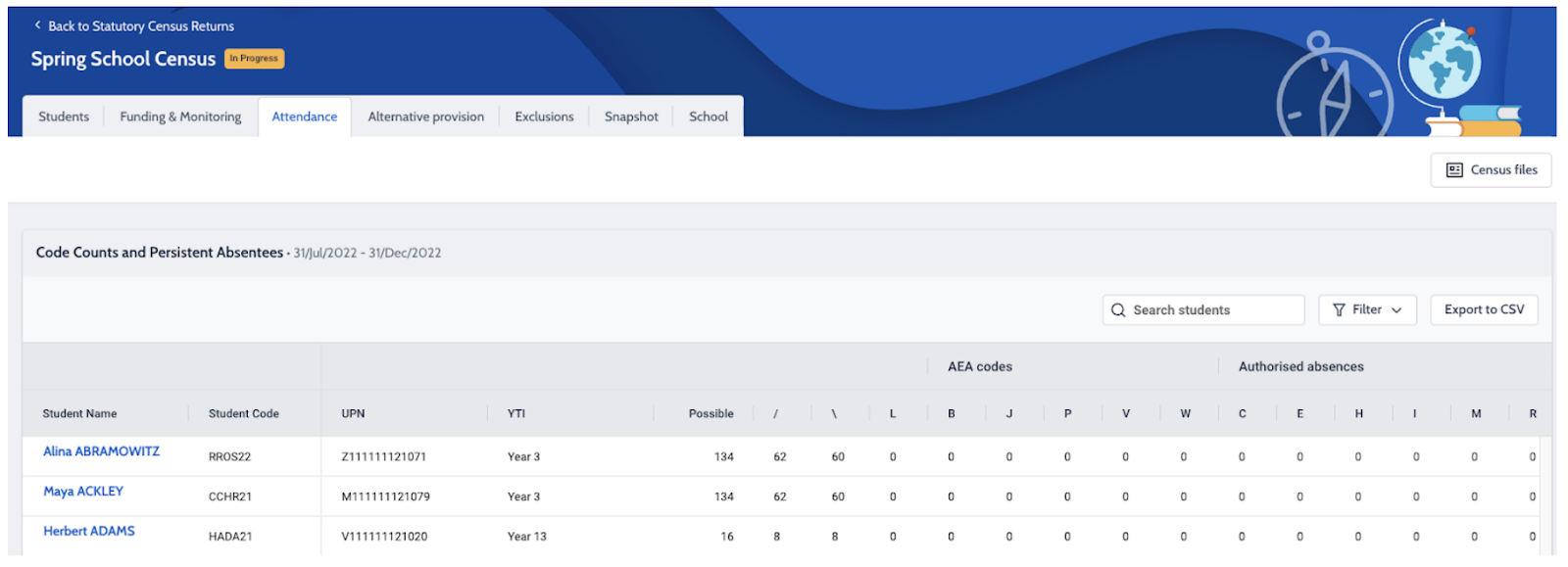
Right, so let’s take one universal part of the system, and one quite advanced area. Starting with the universal, we’re really proud of how School Census works. Because Australia doesn’t really have an equivalent concept, we basically got to design this bit of the software for the UK from the ground up. When you look at it you see straight away that everything you need to do is visible in one set of windows. We’ve also set up the flow so that only relevant students are displayed. Everything is also easy to export to spreadsheets for checking. It’s been so well-received that we’ve even just had some schools import data before they go fully live so they can run census through us. That makes us proud of the approach we’re taking. 


School Census in Compass


Then perhaps the most advanced part of the Compass offer is timetabling, which we offer through our Griddle module. You don’t have to use it if you adopt Compass, so It’s a great example of how we can be a one stop shop or part of a modular ecosystem in a school or MAT.


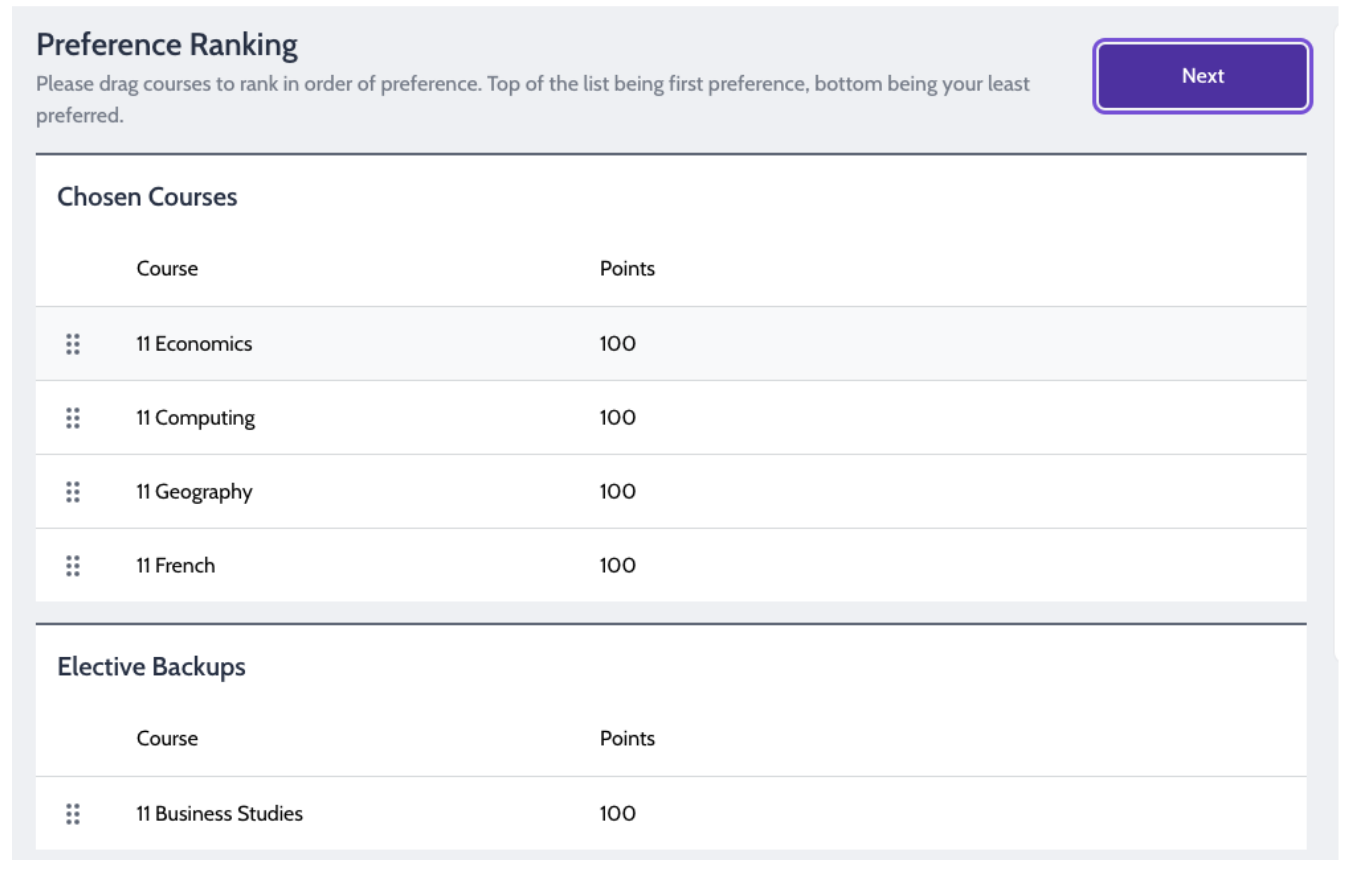
But if you do take on Griddle, the first thing you’ll discover is that it’s designed to cater for the best interests of both students and staff - for example there’s the ability for pupils to choose their options online, and that feeds straight into Griddle. Schools can create rules about which groups of subjects students can choose from, or define a range of pathways, such as academic and vocational. In terms of the Timetable itself, specific staff can be assigned to classes, or groups of staff can be used - such as “KS3 English teachers”. The Timetable Engine will then optimise the scheduling of the timetable, taking into account all of the requirements for staffing and also the distribution of classes and teacher load. It’s incredibly powerful and is a real step forward from what we’ve seen schools using to date.


Students selecting their options and preferences in Griddle


Oh and actually let me throw in one more thing. A nice part of the Compass package is something called Kiosk which is totally unique. It’s a physical terminal which sits by the school's reception and handles things like sign-in and sign-out, both for visitors and students, who can use Compass-issued access cards for this purpose. If a school chooses, their registers can be fully automated based upon student and staff tap-in and tap-out. Kiosk can also handle cashless catering using those same cards. We think this combination is a first for a UK MIS. 


Besides features, what’s something special about the Compass software?


A common thing we constantly hear from our schools who switch over is the user experience for staff and parents. We know schools are time-poor and their staff have a vast disparity of technical experience and confidence. Yet, School software can often be outdated compared to corporate technology or more modern apps such as social media platforms. It makes no sense! At Compass, we are constantly thinking about the end user. We have a modern UX design, simple navigation and colour coding to make Compass easy to learn for new users. We have a dedicated team of UX designers working day and night to make Compass intuitive, which is heavily led by customer feedback. That’s our specialty, I think, making complex tasks as simple as possible, with information easy to find and accessible to the whole school community.


Nice! So where are you now in terms of the UK schools market? How many schools do you have, how big is the team, and so on?


Well, we’ve had a good first year, with over 25 schools already signed up. As you know one of those went live in the autumn, and we were up to five by January. The rest will go live over the coming months. The key thing to say is that we don't rush schools, but we are able to accommodate their needs if they need to move quickly. We let them go live at their own pace.


The team consists of over 200 employees from all around the world, with a large proportion of them dedicated to the UK market. Currently, 15 of these employees are based in the UK, and the team is continuing to expand rapidly.


In that case, I should probably ask you what you have to say to people considering a job with Compass? 

We’re growing and we’re well-funded. Being a global organisation also brings opportunities - we’re very supportive of our UK team spending time in Australia and Ireland, for example. 


As for the type of people we hire, when interviewing, the first thing we look for is cultural fit. That cuts both ways - we need to make sure we hire people who are going to get what they need to be successful. We also offer plenty of geographical flexibility as we fully embrace hybrid and remote working for all roles. 


What I’d also like to make clear is that as a fast growing organisation, our senior leaders of the future are joining us now. So I guess it’s not quite a chance to get in on the ground floor, but we’re not much past the mezzanine!


Find out more about Compass and contact them via their website. 


Wednesday, 21 December 2022

MIS MARKET MOVES WINTER 2022: What Did The SIMS Spreadsheet Say?

Disclaimer: I have past and present commercial relationships with many MIS vendors, including an ongoing involvement with Compass. I'm also a co-founder of two assessment startups - Smartgrade and Carousel - that exist in markets adjacent to the MIS. Nonetheless I aim to write this blog impartially, from the perspective of a neutral observer. This matters to me - it's basically the blog I wish had existed back when I was a MAT senior leader trying to get a handle on MIS and edtech. I also now provide MIS market datasets and reports as a service and offer free, informal consultations on MIS procurement to schools and MATs. If you would like to discuss any of this, contact me on Twitter or LinkedIn.

As a startup founder, here's the rough model I use for how to build a successful business:

  1. Build an innovative minimum viable product.
  2. Listen to your customers and their suggestions for how to make your good idea into a truly great product.
  3. Market your company in a way that is warm and appealing to your customers and partners.
  4. Find the optimal price that allows you to become profitable while also offering great value to your customers.
But it's not the only way! In fact it's not even necessarily the *right* way to run a well-established business, at least from a "maximising shareholder value" perspective. So established companies sometimes adopt very different strategies from startups. Those methodologies may look a bit weird and unfriendly from the outside, but that doesn't mean they're wrong in terms of profit maximisation. For example, the owners of 118118 had declining turnover every year in the decade to 2018; but still made a £2.4m profit and withdrew a £64m dividend that year. So sometimes the best way to run a company (from the perspective of shareholders) is to find ways to limit the decline and maximise revenue from the customers that remain. That may not look cuddly to customers, but it might work out just fine financially.

So there was a world where I could be writing this blog and reporting on SIMS declines after a year of contract tussles and CMA investigations, and the headline could still be "SIMS will probably be happy with that". My guess is that SIMS has a spreadsheet that was crafted sometime in 2021, and that spreadsheet predicts declines in their market share, while also setting a range for those declines which would be considered acceptable. So to evaluate the past year for SIMS, what we're really trying to do is guess what level of churn they could live with.

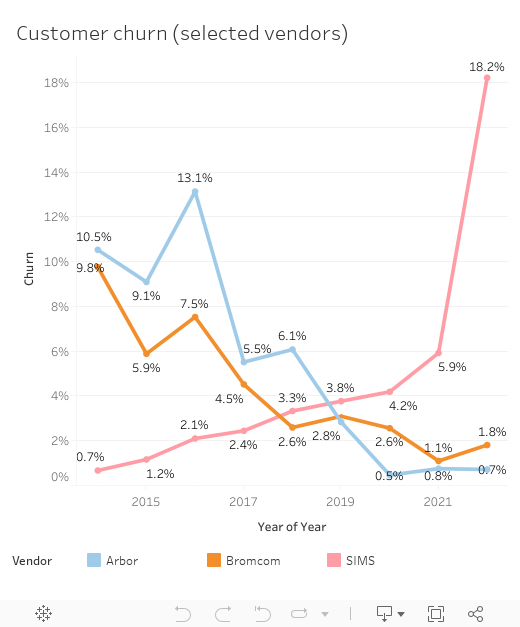
Well, I imagine it was lower than this:
 

To summarise, over the past year SIMS lost 18% of their market share. 2,734 English state schools took a look at what SIMS was offering and decided to move elsewhere. To put that in context, almost 3 times as many schools left SIMS over the past year compared to the previous 12 months (2022: 2,734; 2021: 942). 

The above chart also shows the churn rates for the leading challengers. Both Arbor and Bromcom have churned at under 3% for the past 4 years now, and Arbor has been at under 1% for the past 3 years. 

So does this mean SIMS are toast? Well, not necessarily. If you're SIMS you're really hoping that the three year contracts you've enforced mean that at least the the exodus stops now. You're also keeping your fingers crossed that customers will like your new "Next Gen" product once they see it. And you're no doubt cooking up other strategies to keep customers with you.

So in some senses the MIS market data for the next year tells an even more important than this batch of data from the past year. 2022 was about seeing how big the decline was; but we've known for some time that a decline was inevitable. The big question now is: can SIMS stop the bleeding and return to a relatively stable market share? Come back next Christmas to find out!

Anyway, SIMS aren't the only story in town, so let's move on to the full market picture. Here are my usual charts showing the latest MIS market share of English state schools.
And here are my key takeaways:
  1. RM gave me a new story to tell! Last time out I joked that the RM story always seems to be the same: "they didn't lose that many schools, but they didn't really win anything either". Well, they sure did call my bluff, because while their market share is almost unchanged, they recently dropped the bombshell that Integris is being acquired by The Key. So in other words, RM somehow managed to both trot out exactly the same story and change the narrative at the same time. It's a bit like when Eminem covered that Dido song and the chorus was the same but suddenly there's a thrilling new meaning to everything.
  2. Ian Armitage take a bow. The most important person you might never have heard of in MIS-land is Ian Armitage, shareholder and Chairman at The Key. Having first bought ScholarPack in 2018, and then Arbor in 2020, The Key has now announced its intention to acquire the division of RM that includes Integris. Once the deal goes through The Key will have 7,189 schools in their portfolio - a 33% market share. Looking at academies specifically, The Key have a 38% market share vs 45% for SIMS. To build a portfolio like this takes a really long-term investor horizon and some smart manoeuvring. So hats off to Ian and all those who made this happen. Of course, what they do with Integris post-acquisition is another question altogether: will they move the schools to the Arbor platform, or keep them on Integris over the long term as they've (mostly) done with ScholarPack? That's another one I'll look forward to digging into next year.
  3. Arbor are the winningest MIS. It feels a bit mean of me to bury the lede that Arbor climbed to a 16% market share after gaining 1,887 schools over the past year, but hey, there's been a lot of other stuff to talk about! Anyway, that's over double their share from a year ago. Their position as the leading challenger to SIMS is cemented. 
  4. Bromcom also had a strong year. Let's not lose sight of the fact that Bromcom had a banner year too. They also nearly doubled their number of schools (2022: 1,688 schools; 2021: 885), and their market share measured by pupils is up to 10%. Of the other vendors, only Arbor and SIMS are in double figures. 
  5. Ed:Gen were the next fastest grower. IRIS products (Ed:Gen and iSAMS combined) jumped from 18 to 86 schools over the past 12 months a net gain of 68. This compares with a net increase of 36 for Juniper products (Pupil Asset and Horizons combined). So technically that makes them the fastest growing MIS (though I appreciate that's a bit like saying "standup paddleboarding is the fastest growing sport in the country"; it may be true in percentage terms, but that doesn't mean it's replacing football in the national pscyche just yet...) But in all seriousness, that's significant growth, and IRIS are entitled to give themselves a pat on the back.  
  6. Oh, hello, Compass! If you read the disclaimer at the top you'll know I'm an advisor to Compass, so I take particular pleasure in welcoming a major new player to the English school market! Compass is an Australian company with 2,000+ schools in Australia, Ireland and now England too, serving all phases and types of school. Now they're on the board, it'll be fun to track how they grow in the coming year.
  7. If you're buying SIMS, expect to receive a very personalised sales service. Over the past year SIMS won 23 schools. I checked on LinkedIn and found 26 people with the words "Sales" or "Business Development" in the job title at ESS. Now of course some of them may have left and not updated LinkedIn, and I'm sure others work across customer success / operations / international markets etc... but still, if you're a new SIMS customer you can assume you'll have a very attentive salesperson looking after you. 
  8. The switch from ScholarPack to Arbor has started. One thing I've been keeping tabs on is whether The Key move schools from ScholarPack to Arbor now they own both. The answer until now has mostly been no, but this past year there are signs that a switch has started. In total 43 schools left ScholarPack, of which 34 went to Arbor. 
  9. Others are coming. Satchel recently announced that they're building an MIS. ET-AIMS and Go4Schools are either in the MIS market or looking to enter (I assume ET-AIMS has some independent schools; I'm not sure if anyone is live with Go4Schools yet). So it's fair to say that we can expect further new entrants over the coming years. 

Thursday, 15 September 2022

Free Oak National!

To date I’ve been broadly pro-Oak. But I can see why some people don’t feel that way, and I sympathise. 

The case against it - particularly in its new life as an Arm’s Length body of the Department for Education - is easy enough to understand. People worry about scope creep. The expanded Oak could undermine the businesses of existing publishers; so if I was in that segment I guess I might have concerns too. I also think it’s reasonable for people to worry that, while Oak says now it will be independent and optional, its mere existence and close relationship with government means that these freedoms may not always be guaranteed.


But in the most general sense, I remain a fan. I think additional help for teachers in planning and offering lessons is A Good Thing. I also don’t object philosophically to the government inserting themselves into a commercial market. As an edtech vendor (I’m a co-founder of Smartgrade and Carousel), I do not expect or want all educational products and services to be provided by the private sector only. It is good and healthy that commercial outfits compete with non-profits, MATs, schools and, in some circumstances, government directly. Indeed, when it comes to curriculum resources specifically, plenty of the innovation of the past few years has emanated from excellent non-commercial organisations like White Rose Maths, NRICH, Primary Knowledge Curriculum, Ark Curriculum Plus and CUSP. 


So what I’m basically saying is that a debate about Oak is healthy. To get the best Oak possible we need to put aside dogma and engage with how to make Oak work well for everyone. And by everyone I mean schools, teachers, students, parents, curriculum providers and edtech vendors.


And in terms of that final constituency, I’m increasingly concerned that a huge opportunity will be missed in how Oak is proposing to operate. I’ve just read through the Oak Market Engagement slides and what they say is this:


Full Curriculum Packages will be shared on a Creative Commons licence (excluding third party copyrighted content within a lesson, such as works of art or literature).


And:


Any existing curriculum and/or resources owned by the Supplier (Supplier IP) that is used in the development of the Full Curriculum Packages for the purposes of the Contract remain the property of the Supplier. The Supplier retains the right to commercial and other usage of those existing resources.


The use of Creative Commons is welcome - it means that teachers can download, remix and share resources without fear of breaching copyright. 


But what’s missing is that as things stand, the license seemingly does not allow for commercial use by third parties other than the organisation that created the content in the first place.


Why is that an issue? Well, an important thing to understand about edtech is that vendors selling educational resources have to do two things: create great resources and build high quality technology. They’re both really hard and very difficult tasks! So what happens in practice is that either:


  • Vendors have a vision for innovative technology, and so either outsource content creation to users, or design mediocre content.

  • Vendors have a vision for great content, but they’re not natural technologists, so their tech platforms are often a bit ropey.


Now, one quite surprising thing about Oak, given the speed at which it came about, is that it did a really good job of building nice tech as well as creating lessons. But, I think even they would acknowledge that a reason for this is that they kept their tech ambitions limited: they’re a lesson delivery platform, not a full learning platform. So they host videos and pdfs and basic quizzes and such, and they let users access those things very rapidly. However, they’ve been careful not to allow their technology brief to get too broad, and I’m not sure we should want or expect them to do more than make great resources easily accessible online.


We already know that one supplier isn’t going to win the right to create all Oak content - they have announced a cap of four lots in every procurement cycle explicitly to prevent this. So I worry that we could end up with free Oak resources on the simple-but-very-usable Oak site, and then bits and bobs of commercial reuse from the content creators only in their own closed ecosystems.


Instead, what I’d love to see is that Oak resources become available to all, including any edtech vendor, so that innovators can use this valuable content in their products. If that happens I would expect that vendors would:


  • Enhance Oak’s assessment capabilities. Right now Oak contains simple multiple choice quizzes. That’s fine as a starter, but it’s only a small part of the school assessment picture. Innovators would be able to make Oak’s quizzes available in other formats (e.g. free text quizzes); write new (and quite possibly better) questions; and innovate with other assessment approaches (e.g. retrieval practice or end of year assessments). Oak can’t possibly do all that, but the sector can, and teaching would be better for it.

  • Embed Oak lesson content in their learning platforms, allowing that content to be integrated into the software that schools are already using. That’s surely what customers want, and Oak should make it possible.

  • Apply new technologies such as AI (don’t laugh, I’m sceptical about lots of AI too) to the content. I think there’s great potential here in terms of content and assessment sequencing. For example, I was intrigued by the recent Microsoft/Eedi blog on using AI for next best question models. 

  • Allow teachers to remix and share Oak content. Lesson content doesn’t want to be static. Great teachers take existing resources and adapt them for their particular contents and pedagogies. The right technology would help inspired teachers share enhanced resources with their peers.


And honestly, I’m not sure I even understand the reason why the government wouldn’t do this. (I can imagine reasons some suppliers wouldn’t want this, but if that’s the case then they’re best placed to explain why, and I’ll look forward to hearing their views!) The DfE will pay out £8m to curriculum providers in the first round of procurement alone. They get to set the rules of the tender process. Surely they should want content provided in a way that allows for the maximum impact? They’re paying for it with all of our taxes; so why put limits on how the IP will be used?


More broadly, Oak hasn’t always had an easy time engaging with education suppliers. I’m sure some people will always be against them, but here they have an opportunity not just to win over a chunk of the sector, but more importantly to harness the amazing UK edtech sector’s ingenuity and ambition. Just imagine what companies like Twinkl, Sparx, Century, Google, Microsoft, Firefly, Quizlet - and of course let’s not forget Carousel and Smartgrade! - could do if they were at liberty to incorporate Oak resources into their offer however they wished. 


If we leave Oak content locked behind a non-commercial Creative Commons library the edtech sector will never get to interact with it, and it’s content will be much the poorer for it. 


Free Oak National!


Tuesday, 26 July 2022

MIS MARKET MOVES SUMMER 2022: SIMS lose 1,471 schools in a term

Disclaimer: I have past and present commercial relationships with many MIS vendors, including an ongoing involvement with Compass, an Australia-based MIS that is launching in the UK. I'm also a co-founder of two assessment startups - Smartgrade and Carousel - that exist in markets adjacent to the MIS. Nonetheless I aim to write this blog impartially, from the perspective of a neutral observer. This matters to me - it's basically the blog I wish had existed back when I was a MAT senior leader trying to get a handle on MIS and edtech. I also now provide MIS market datasets and reports as a service and offer free, informal consultations on MIS procurement to schools and MATs. If you would like to discuss any of this, contact me on Twitter or LinkedIn.

After buying SIMS in the summer of 2021, new owners ParentPay had some big calls to make. With customers moving to competitors at an increasingly rapid rate, they had to make both technical and commercial decisions: 

  1. Technically, should they persist with SIMS Primary, the pre-existing cloud initiative, or ditch it and build something new from scratch? 
  2. Commercially, how should they present to the market? A charm offensive, perhaps, or discounted pricing to keep schools onside? Or could they find a way to somehow keep schools and raise prices?

Well, as we now know, SIMS chose to: 

I don't want to get into the ethics of such an approach in this blog, but I do want to reflect on what you might have hoped for if you were the management team behind such a move? SIMS had lost 6% of its schools over the previous year, and so you'd surely be bracing yourselves for an increase on that. It follows that you'd probably bite someone's hand off for 7% churn in the following year? Maybe you'd even take 10% if you felt what you gained in return was valuable enough? 

Well, we now have data covering English state schools over the crucial period up to May 2022, and we can see that this is what they got:


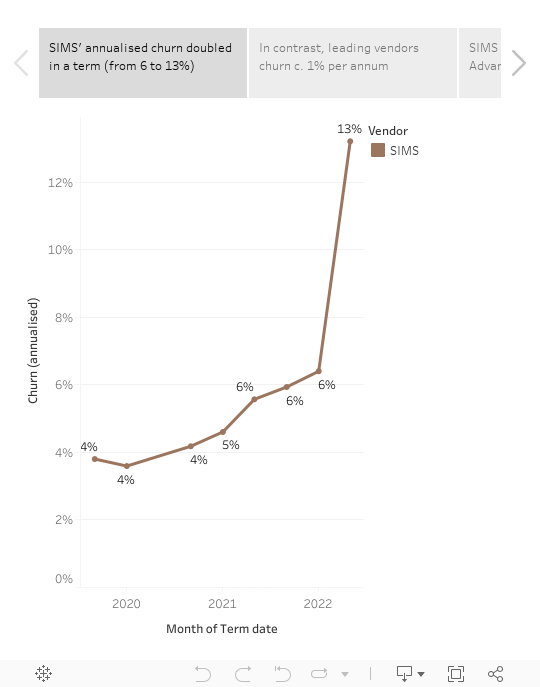
What you're looking at in the first tab of that viz is SIMS's annualised churn (the number of schools leaving in the past 12 months as a percentage of total customer base a year ago), recalculated each term. And what jumps out is that between January 2022 and May 2022, churn more than doubled (to 13% from 6%). That equates to a loss of 1,471 schools over the term, and 2,024 schools over the past year. The only other major MIS in recent times to churn at that level is Advanced Learning, and they've dropped from around 1,300 schools a decade ago to under 200 schools today. The leading cloud vendors, in contrast, all churn around 1% these days. So I think it's fair to say that 1,471 schools in one term is a lot by any measure!

Anyway, this is not just a story about SIMS, so let's move on from churn and take a look at the overall market data:


As always, these Tableau vizzes are designed to let you explore the data yourself; but here are my reflections having had a proper rummage through:  
  1. Arbor remain the leading challenger and are now the second largest vendor overall. Arbor won 1,033 schools in one term, taking their total to 2,913. That's happened less than two years after they passed 1,000 schools in total. They also won the most schools in each of the following categories: primary, secondary, PRU&Special, Academies and LA schools. The performance with LA schools was particularly eye-catching, acquiring 447 schools over the period (the next most was Bromcom with 65), bolstered by their prominent position on the Herts for Learning MIS framework.
  2. Bromcom are also making big strides. In any other term, Bromcom's numbers would have made them the box office performer. They added 367 schools - more than Arbor has won in any previous term, and similar to the number Bromcom won over the previous five terms combined. And this only includes a handful of the schools they expect to join following their success with the recent West Sussex tender - so we know there's more to come. It's also notable that Bromcom are now the third largest vendor when the market is measured by pupil numbers, with RM Integris dropping down to fourth.
  3. Other challengers are picking up the pace. IRIS Ed:Gen (a version of iSAMS for state schools) gained 40 schools and Juniper Horizons (a reworked version of Pupil Asset) gained 31. For IRIS the change is particularly noteworthy, since they only started the period with 18 schools.** Both will find reasons to be cheerful in that performance.
  4. ScholarPack aren't going anywhere either. Given that ScholarPack and Arbor now share an owner (The Key), it's reasonable to speculate as to whether ScholarPack schools will be migrated on to the Arbor platform at some point. Well, the data shows us no sign of that happening yet, with ScholarPack gaining a healthy 93 schools during the term and losing just 2. So it looks like the company is committed to dual-running both products for the time being. 
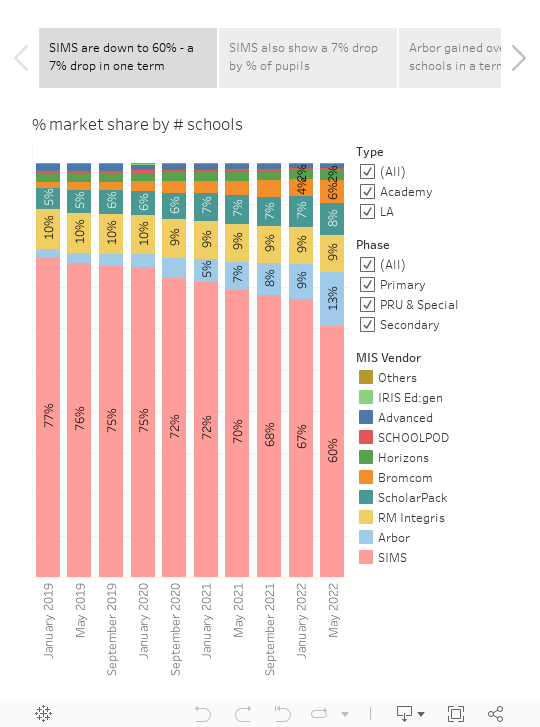
  5. SIMS are down to a 60% market share. I know I already banged on about SIMS' churn above, but it's worth taking time to acknowledge their overall performance too. Beneath the 60% headline figure, what stood out to me is that SIMS are down to 50% of all academies (you can see this for yourself by using the checkboxes on the first tab of the viz to select academies only). SIMS dropped below a 50% share of large (30+ school) MATs in autumn 2019; and as I've said before, larger MATs lead the way in terms of how smaller MATs behave. I'll dive into the various different MAT size categories in more detail when I look at annual data based on the Autumn 2022 census.
  6. What to make of RM Integris? I have lost count of how many times I've written a paragraph about Integris that can be summarised as "they didn't lose that many schools, but they didn't really win anything either". If ever there was a term to break that trend, this was it. And you know what...? They didn't lose that many schools, but they didn't really win anything either! ðŸ¤·‍♂️ 
  7. Advanced are in serious trouble. As was to be expected after losing the AET contract to Arbor, Advanced dropped from 244 to 186. Their annualised churn is at almost 40%. It's hard to see a way back from here.
  8. Faronics are gone... I married a Canadian, so I was kind of excited when Vancouver-based Faronics came to the UK in 2018. Well, it's time for me to get un-excited because they're now officially out of the English state school game after their lone school migrated to Bromcom. I'm honestly a bit sad aboot it.
  9. ... But new names are coming. I was interested to hear SIMS founder Phil Neal big up the ET-AIMS team on a recent fireside chat with Nick Finnemore - so I'd expect to see some schools for them in future updates. And Compass, the Australian MIS I work with, have a healthy pipeline of schools to onboard in the coming months too. When you put those two alongside IRIS, Juniper, Bromcom and Arbor, it means there are now six legitimate growth cloud options. If I was a school procuring an MIS I'd want to take a quick look at all of them before kicking off a procurement exercise - you've got more choice than ever before!
A final thought about SIMS: while this set of data is noteworthy, I'd argue the next 12 months will actually be a better indicator of the product's long term health. I guess 13% churn is bearable if it stops there! But if schools continue to leave in high volumes this autumn, and then more switch away from SIMS in 2023, it'll become increasingly hard for ESS to complete a turnaround. In theory I assume the three year lock-in was designed to prevent further churn beyond Easter 2022, but with that arrangement under investigation by the CMA, and leading MIS vendors publicising policies that only charge schools for a new MIS once their old contract has expired, I don't think we should see it as guaranteed that the SIMS switching will stop anytime soon.


* Schools were subsequently offered a six month break clause, but the broader strategy has essentially remained unchanged.

** Those 18 pre-existing schools were technically on iSAMS, but I group them together for the purposes of this analysis since the products are close relations.

Sunday, 10 July 2022

The latest on SIMS Next Gen

Disclaimer: I have past and present commercial relationships with many MIS vendors, including an ongoing involvement with Compass, an Australia-based MIS that is launching in the UK. I'm also a co-founder of two assessment startups - Smartgrade and Carousel - that exist in markets adjacent to the MIS. Nonetheless I aim to write this blog impartially, from the perspective of a neutral observer. This matters to me - it's basically the blog I wish had existed back when I was a MAT senior leader trying to get a handle on MIS and edtech. I also now provide MIS market datasets and reports as a service and offer free, informal consultations on MIS procurement to schools and MATs. If you would like to discuss any of this, contact me on Twitter or LinkedIn.

I'll soon be getting hold of the May MIS census figures from English state schools, and it's a big release for SIMS-watchers. Why? Well, in November last year the company announced that schools would be required to move from their previous annual contracts to mandatory 3 year contracts, and, let's just say the news wasn't universally well-received by their customers! SIMS contracts run from 1st April to 31st March, so the immediate effect of this change was that schools had to decide whether to stay and accept the longer contract, or go elsewhere fast. (A couple of months later SIMS did offer a six months break clause after what Schools Week describes as a "backlash" from schools, but still, you'd assume that if there will be an increase in switching, we'll see evidence of that in the May data.)

So to help make sense of the imminent data release, I thought I'd investigate how SIMS are presenting their offer almost a year after the acquisition by ParentPay. But before we check out the latest announcements, here's some context. In September 2021 Mark Brant (Group CEO of ParentPay) set out his highlights from the first 5 weeks of owning SIMS. This included announcing that they were "massively out-investing all our MIS competitors" and that they would "spend more than £40 million to modernise the product portfolio and radically improve the quality and breadth of the services ESS delivers". He also talked about a culture of "less bureaucracy and fast decision making".

Then In October 2021, Brant announced Next Gen SIMS, offering "Cloud-based, continuous improvement from Spring 2022". This was newsworthy for a couple of reasons: 

    • It sounded like a tacit admission that SIMS Primary, their pre-existing cloud initiative unveiled in January 2018, was being shelved.
    • But it also sounded like there was a Big New Plan - "Next Gen will be deployed as pure cloud-based applications and will sit alongside existing SIMS features", says Brant. This appeared to mean that existing SIMS would be available in its current form via a browser, alongside new native-cloud modules. In an approach described as "Evolution, not revolution", the implication was that the user would get all of SIMS in a browser, with the old bits being replaced one by one with new cloud SIMS. The article implied a quick rollout - Brand says "Best of all, these improvements will begin to be delivered for all our SIMS schools at no additional cost, starting in Q1 2022."

So where are SIMS now? Well, this recent sponsored post in Schools Week provides something of a progress report. First, it reiterates the £40m development pledge, and says of Next Gen that the "first slice of technology is Take Register for primary school teachers", which has been piloted in "dozens of schools". Here's the part about new functionality in full:  

Cover teachers can now take registers when the regular teacher is absent; users can view notes against attendance marks; and we’re working to ensure users can add and edit new notes, too. Our development teams are also making progress in adapting Take Register to make it suitable for secondary schools. You can find out more about Take Register by clicking here. 


I’m also very pleased to report that another slice of SIMS Next Gen has recently gone into pilot mode. Teachers need quick and easy access to the contact details for parents and/or guardians of their learners. We’ve been developing our Learner Contacts functionality to do exactly that. Look out for an update on where we are with this in our next piece!


I also found this April 2022 article from the SIMS blog useful to understand how the company is coping with the tricky technical challenge of running Next Gen and SIMS 7 side by side. It says:


        It takes just five minutes for Take Register’s data to be synchronised back into SIMS.


Or, to put it another way: Take Register doesn't update the SIMS database in real time; there's seemingly a process it goes through before committing any changes.


Then the latest article on the SIMS website includes further details on planned developments:


Our next slice, which is currently in pilot, is Pupil Contacts functionality. The ability to use Pupil Contacts on a mobile device has proved popular, due to its accessibility for activities that happen outside the school building.   


The team is now focused on moulding enhancements around the insight and feedback that they’ve received from the pilot. In fact, changes have already been made – such as improved search functionality to support more flexible inputs, or ‘fuzzy’ search and design improvements to make it easier to move around the various features. There’s more to do to, such as optimising Pupil Contacts for tablet screens, before we roll out the slice to all Primary Schools. 


And we’re delighted to announce plans to take our latest slice, our MAT reporting tool, into pilot later this year. This is powerful technology, which harnesses AI and Machine Learning, to identify areas of concern surrounding attendance.


My interpretation of all this is:

  1. The pace of SIMS Next Gen is ramping up - we're getting more and more information shared with us, and there are now several areas either in development or being piloted.
  2. That said, the only thing that will be live at any scale for the new academic year is "Take Register". And even then, that's currently in pilot for primaries only, though a wider rollout is planned for the summer. 
  3. SIMS aren't rushing to release Next Gen screenshots (I can't find any on the blog or elsewhere).
  4. Users can't yet add and edit new notes via Take Register (which may be linked to the technical complexities of running a local database and a cloud module side by side?). 
  5. The rollout of Next Gen will be a long-term, multi-year thing. After all, SIMS has *lots* of modules, and plenty of them (like behaviour and attendance, say) are not mentioned yet.
  6. Improving the experience on phones and tablets is a priority - though the expectation is seemingly for such access to be via a browser with responsive design rather than through native apps; otherwise it wouldn't make sense to say "optimising Pupil Contacts for tablet screens". I'm not clear what that means for the future of the SIMS Teacher App.
  7. MAT Analytics is a new focus area, presumably to improve MAT retention, which has been a particularly challenging area for SIMS in recent years. That's very much my thing, so I'll be watching for further announcements in this area with interest. In particular I'll be looking for specifics on how they plan to bring in AI and ML to attendance analytics. Or to put it another way, what will AI do that a rules-driven report ("show me pupils who have <95% attendance") couldn't? As I've blogged about before, AI is only the answer in edtech if you have a clear understanding of the question you want it to answer, and why traditional approaches aren't up to the job. Don't get me wrong, SIMS could have great answers to these questions! I just don't know what they are yet, so I'll be excited to find out more...
Will this be enough to stop schools and MATs from switching away from SIMS? Well, I prefer data to speculation, so hang tight for my imminent blog about the May 2022 census data to find out!